.webp)
- A PEO (Professional Employer Organization) is a firm that enters a co-employment relationship with your business to manage HR, payroll, benefits, and compliance, while you stay in control of hiring and day-to-day operations.
- The PEO becomes the employer of record for tax purposes, handling payroll taxes, filings, and HR administration behind the scenes through a Client Service Agreement, while you direct your employees and run your business as usual.
- A full-service PEO covers payroll processing, employee benefits, workers compensation, HR compliance, risk management, recruitment support, employee training, and HR technology portals, though service scope varies by provider and contract.
- The average PEO costs $1,395 per employee per year but saves businesses $1,775 annually, a net ROI of 27.2%. PEO clients also grow twice as fast and report 12% lower employee turnover than non-PEO companies.
Ready to simplify your global expansion? Reach out to us today!
Discover how we create impactful content.
Managing payroll, benefits, and compliance while running a business is where most small companies lose time and money.
Over 500 PEOs in the U.S. serve 200,000+ businesses, but what is a PEO company exactly, and why are so many SMBs turning to them? (NAPEO).
If you have been asking what is a PEO and whether it is right for your business, this guide covers how PEOs work, services included, real costs, benefits, risks, how they compare to EOR and other HR outsourcing models, and how to choose the right partner. Let's break it down.
What is a PEO (Professional Employer Organization)?[toc=What is a PEO?]
A PEO short for Professional Employer Organization, is a firm that enters into a co-employment relationship with your business to manage HR, payroll processing, employment taxes, benefits administration, and regulatory compliance.
Your company remains the worksite employer, you hire, manage, and direct employees day-to-day. The PEO becomes the employer of record for tax and insurance purposes, handling HR administration behind the scenes.
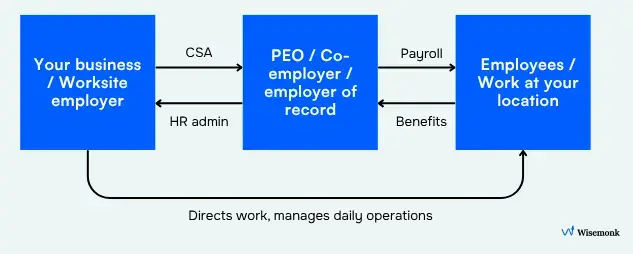
PEOs primarily serve small to mid-sized businesses with 10 to 1,000 employees, companies that need enterprise-level HR infrastructure without the cost of building it in-house. The industry has been around for over 30 years, with 700+ PEOs operating across the U.S. today.
If your business is expanding beyond U.S. borders and needs to hire globally, a PEO alone may not be enough. That's where an Employer of Record (EOR) comes in, which we'll cover later in this guide.
How does a PEO work?[toc=How It Works]
To fully understand what is a PEO in practice, it helps to see exactly how the co-employment arrangement operates day to day.
A PEO operates through a co-employment arrangement where your company and the PEO share employer responsibilities under a Client Service Agreement (CSA). You stay in control of business decisions, hiring, and day-to-day operations. The PEO becomes the co-employer, handling HR administration, payroll taxes, and compliance, typically for a flat monthly fee or a percentage of total payroll.
What PEOs actually handle
- Payroll processing, tax filing, and pay stub issuance
- Health insurance, retirement plans, and employee benefits at group rates
- Workers' compensation insurance and claims management
- HR compliance across federal, state, and local labor laws
- Employee onboarding, relations, performance management, and offboarding
- HR technology, dashboards, self-service portals, and reporting tools
- Employee handbooks and policy development
What PEOs don't control
- Hiring and termination decisions, that's always yours
- Salary and compensation setting
- Job assignments and performance management
- Business strategy and operations
- Company culture and day-to-day management
- Marketing, sales, and product decisions
What changes for your employees
Employees will see the PEO's name on their W-2s and paychecks since the PEO is the employer of record for tax purposes. Their day-to-day work, reporting structure, and management don't change at all. Most employees notice the difference only in better benefits and a smoother HR experience.
At Wisemonk, managing payroll and compliance for 2,000+ employees globally, we've seen firsthand how co-employment frees up leadership bandwidth, letting founders focus on growth instead of HR administration.
What services do PEOs provide?[toc=PEO Services]
Having helped 300+ global companies manage HR, payroll, and benefits, we've curated the key services a full-service PEO typically covers.
- Payroll and tax administration Processing payroll, filing federal and state employment taxes, issuing W-2s, and managing garnishments and deductions, all handled by the PEO on your behalf.
- Employee benefits Access to health, dental, vision, life, and disability insurance at group rates, plus retirement plans like 401(k). Small businesses get Fortune 500-level benefits without Fortune 500 headcount.
- Workers' compensation insurance PEOs manage workers' comp coverage, claims administration, and workplace injury reporting, often at lower rates than businesses can negotiate independently.
- HR compliance support Monitoring and ensuring compliance with federal, state, and local labor laws, wage and hour rules, leave mandates, ADA, FMLA, and more. Especially valuable for multi-state operations.
- Risk management and workplace safety Safety program development, OSHA compliance support, and employment practices liability protection to reduce your legal and financial exposure.
- Recruitment and onboarding Job posting support, background checks, offer letter templates, and structured onboarding workflows to get new hires productive faster.
- Employee training and development Access to training libraries, compliance training (harassment prevention, safety), and professional development programs, without building them in-house.
- HR technology and employee portals Modern PEOs provide self-service dashboards where employees can manage their benefits, view pay stubs, request time off, and access HR documents, all in one place.
What is a PEO provider exactly? It varies. Some specialize in specific industries or geographies, while others offer add-on services at extra cost. Always confirm what is included in your base contract before signing.
Now that you know what PEO services cover, understanding the cost is the next step to deciding if it's the right fit for your business.
How much does a PEO cost?[toc=Cost of PEO]
PEO pricing depends on your headcount, payroll size, and services bundled into the agreement. Most U.S. businesses pay between $900–$1,800 per employee per year in admin fees, through one of two models:
- Percentage of payroll: Typically 2–12% of gross payroll
- Flat per-employee fee (PEPM): Usually $40–$160 per employee per month
According to NAPEO, the average PEO costs $1,395 per employee per year, but clients save an average of $1,775 per employee annually, a net ROI of 27.2%.
For a full breakdown of pricing models, hidden costs, and real cost scenarios by business size, read our complete guide on "Cost of PEO Services (2026): Pricing, Fees & ROI Guide"
What are the benefits of using a PEO?[toc=Benefits of PEO]
Working with a professional employer organization can reshape how businesses manage people, compliance, and costs.
In our experience helping companies expand globally, the benefits of partnering with a PEO go well beyond HR admin relief. The data backs it up:
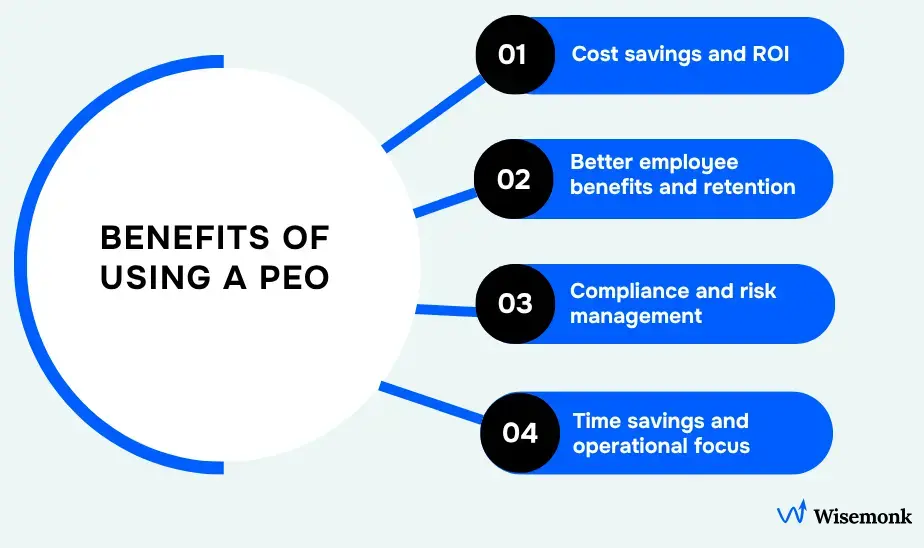
Cost savings and ROI
According to NAPEO, businesses spend an average of $1,395 per employee annually on PEO services, but save $1,775 per employee per year, a net ROI of 27.2%. Those savings come from:
- Lower workers' compensation rates through pooled coverage
- Reduced health insurance costs via group purchasing
- Fewer compliance penalties and legal fees
- Eliminating the cost of hiring and training in-house HR staff
Better employee benefits and retention
PEOs pool employees across multiple client companies to negotiate group-discounted rates on benefits most small businesses can't access independently.
- 52% of PEO users offer retirement plans vs. 23% of non-PEO companies
- Employees get access to medical, dental, vision, life, and disability coverage
- PEO clients report 12% lower employee turnover than comparable non-PEO companies
- Better benefits directly improve recruiting competitiveness
Compliance and risk management
Labor laws change constantly across federal, state, and local jurisdictions. PEOs monitor and manage compliance so you don't have to.
- Expert navigation of wage and hour laws, FMLA, ADA, and state-specific mandates
- Workers' compensation claims administration and OSHA compliance support
- Employment practices liability protection
- Reduced audit risk across payroll taxes and filings
Time savings and operational focus
70% of business leaders spend at least one week per month on HR-related tasks. A PEO takes that off your plate, payroll processing, benefits administration, onboarding, and routine HR functions, so leadership can focus on growth.
PEO clients also grow at twice the rate of comparable businesses and are 50% less likely to go out of business, according to NAPEO.
Understanding what a PEO is in HR is one thing, but knowing the tradeoffs is what separates a good decision from a costly one.
What are the drawbacks and risks of using a PEO?[toc=Drawbacks & Risks]
A Professional Employer Organization can be a game-changer, but it’s not without tradeoffs. In our experience as a leading Employer of Record , businesses should weigh these risks before signing a service agreement.
Key drawbacks include:
- Loss of direct control over benefits carriers and plans: The PEO negotiates benefits on behalf of all clients, not just yours, limiting your ability to customize plans or switch carriers freely.
- Costs can increase over time as PEO adds riskier clients to pool: As the PEO onboards higher-risk businesses, your benefits premiums can rise even if your own workforce risk profile stays the same.
- Employee confusion about employer identity and W-2s: Employees see the PEO's name on paychecks and tax documents, which creates confusion about who their actual employer is, especially during onboarding and tax season.
- Potential communication delays with third-party: Since HR is managed externally, response times on employee issues, payroll queries, or compliance questions can be slower than handling them in-house.
- Unclear liability division if PEO makes tax filing errors: If the PEO mishandles payroll tax filings, your business can still face IRS penalties. Liability clauses in contracts are often vague and worth scrutinizing carefully.
- Cultural disconnect if PEO not aligned with company values: Standard PEO policies and processes may not reflect your company culture, creating friction in how HR is experienced by your employees day to day.
- Difficulty accessing HR data for strategic decisions: Some PEOs restrict or delay access to workforce data, making it harder to run analytics or make informed headcount and compensation decisions quickly.
- Exit challenges and transition complexity: Leaving a PEO requires migrating payroll systems, benefits coverage, workers compensation policies, and employee records, which takes significant time and planning.
Pro Tip: Always request a detailed service agreement breakdown before committing to a PEO. Verify who holds liability for tax errors, what your exit terms are, and whether benefits rates are locked or subject to pool-based increases at renewal.
Before choosing a PEO, it's worth knowing exactly where it stops working - and what picks up from there. That's where the EOR comes in.
What's the difference between a PEO and an EOR?[toc=PEO vs. EOR]
Both models help businesses outsource HR and compliance, but they work differently and serve different situations.
A PEO operates through co-employment. You keep your existing legal entity, share employer responsibilities with the PEO, and retain control over hiring, management, and operations.
An Employer of Record (EOR) becomes the full legal employer of your workforce. You don't need an existing entity in the country where you're hiring. The EOR assumes all employment liability, handles contracts, payroll, taxes, and compliance entirely.
For a full breakdown including hybrid models, cost comparison, and decision framework, read our complete guide on "PEO vs. EOR Guide: Key Differences for Global Hiring"
What other HR outsourcing options exist?[toc=Other HR Outsourcing Models]
Businesses exploring HR outsourcing often confuse PEOs with other models like ASO, HRO, and staffing agencies. The difference comes down to who holds employer responsibilities and how much of the HR function you want to hand off.
Here is a quick breakdown of each model:
- ASO: Admin support only, no co-employment. You stay the sole legal employer and pick services a la carte.
- HRO: Vendor-client model for selective HR functions like recruiting or training, no shared liability.
- Staffing Agency: Supplies temporary or contract workers, agency is their direct employer.
- Payroll Provider: Handles payroll processing and tax filing only, nothing beyond that.
- HR Software (HRIS): DIY technology tool, you manage everything yourself with no outsourced expertise.
Now let's evaluate how each stacks up against a PEO:
PEO vs ASO (Administrative Services Organization)
To understand the difference between a PEO and an ASO, refer to this detailed guide on "ASO vs. PEO: Which HR Model is Right for U.S. SMBs?"
PEO vs HR Outsourcing (HRO)
You can refer to this guide on "PEO vs HRO for Small Businesses: Complete Guide" to get a clear picture of the differences between a PEO and a HRO.
PEO vs Staffing Agencies
PEO vs Payroll Provider
For a deeper look at managing payroll across borders, read our complete guide on "Global Payroll Services"
PEO vs HR Software (HRIS)
Want to understand how HR technology fits into your stack? Read our complete guide on "What is HRIS?"
Still not sure which model fits your situation? Here is a quick way to decide:
What is a Certified PEO (CPEO)?[toc=CPEO Certification]
Understanding what is a PEO is step one. Understanding what is a certified PEO is what separates a risky provider from a trustworthy one.
IRS Certified Professional Employer Organization (CPEO)
Established in 2014 under the Tax Increase Prevention Act, the CPEO designation is a federal certification under Internal Revenue Code §7705. A CPEO assumes sole liability for federal employment taxes on wages it pays, giving your business added tax protection.
One practical benefit most businesses overlook: a CPEO eliminates the wage-base restart that typically occurs when joining or leaving a PEO mid-year. This can save thousands in unnecessary payroll tax recalculations.
The IRS publishes a verified list of certified PEOs quarterly. Always cross-check your provider here before signing: IRS CPEO Verified List
Employer Services Assurance Corporation (ESAC)
ESAC independently verifies that a PEO meets strict ethical, financial, and operational standards. Accredited PEOs are backed by over $15 million in surety bonds, protecting clients if something goes wrong financially.
Certification Institute (CI)
This credential focuses specifically on workers compensation risk management. A CI-certified PEO follows proven insurance industry best practices to keep claims low and coverage solid.
Should you only work with CPEOs?
Not necessarily, but it significantly reduces your risk. A CPEO carries stronger federal tax protections and financial guarantees than a standard PEO. If you are evaluating two providers and one holds CPEO status, that is a meaningful differentiator worth prioritizing.
If a PEO holds all three certifications, you are working with a provider that takes compliance seriously.
Is a PEO right for your business?[toc=Is PEO Right For You]
Once you understand what is a PEO, the real question is whether it fits your specific business situation.
Having worked with 300+ global companies across various growth stages, we have seen this pattern consistently: a PEO tends to deliver the most value for companies with 10 to 99 employees.
Here is when it makes sense:
- You are growing fast but have no dedicated HR infrastructure in place
- You struggle to offer competitive health insurance or retirement benefits independently
- You operate across multiple states and need compliance support for varying labor laws
- You have had compliance issues or want to reduce the risk of payroll tax errors
- HR admin is consuming leadership time that should go toward business growth
- You need better workers compensation rates than you can negotiate independently
When you might not need a PEO services:
- You have fewer than 10 employees with straightforward payroll needs
- You already have a strong in-house HR team handling compliance effectively
- You need complete control over every HR decision including benefits carrier selection
- You only need one or two HR functions - a payroll provider or ASO may be a better fit
- You are a large enterprise with the budget and resources for a full HR department
Industry considerations:
PEO services serve businesses across industries but tend to deliver the most value in:
- Professional services: Law firms, consultancies, and agencies with multi-state teams
- Healthcare: High compliance burden, complex benefits needs, and high turnover risk
- Manufacturing and construction: Workers compensation complexity and safety program requirements
- Nonprofits: Limited HR budgets but need for competitive benefits to attract talent
- Technology startups: Fast hiring, distributed teams, and no HR infrastructure
Knowing what is a PEO company helps you decide faster, the businesses that benefit most are the ones ready to outsource HR services and redirect that energy toward core business operations.
How do you choose the right PEO?[toc=How to Choose Right Provider]
Not all PEOs are built the same. The right provider depends on your business size, industry, geographic footprint, and how much HR support you actually need.
Start by verifying these certifications before evaluating anything else:
- IRS CPEO certification - confirms the PEO meets federal financial and tax compliance standards
- ESAC accreditation - independently verified financial stability, backed by $15M+ in surety bonds
- State licensing - confirm the PEO is registered to operate in every state where you have employees
- Insurance coverage - verify workers compensation and employment practices liability coverage
Once certifications check out, evaluate on these criteria:
- Industry experience - a PEO familiar with your sector understands your compliance risks and benefits expectations better
- Geographic coverage - confirm they can support every state you operate in now and plan to expand into
- Technology platform - does the HR software integrate with your existing tools and allow employee self-service?
- Service model - do you get a dedicated HR contact or a shared call center?
- Client retention rate - a strong PEO retains 85%+ of clients annually. Anything lower is a red flag
- References - ask for clients similar in size and industry to yours
Read more: Choosing a PEO: Does Your Business Need One?
Before signing, ask every PEO these questions:
- Who is liable if a payroll tax filing error occurs on your end?
- What is your current client retention rate?
- Can I customize benefits plans or choose my own carriers?
- What happens if I want to exit the agreement early?
- What technology do employees access for self-service?
- How do you handle workers compensation claims end to end?
Understanding what is a PEO provider and how to evaluate one properly is what separates a costly mistake from a long-term HR partnership.
For a detailed comparison of top providers, read our guide on "Best PEO Companies 2026"
The right PEO should answer every one of these without hesitation. Vague answers on liability and exit terms are the clearest red flags to walk away from.
How do you implement a PEO partnership?[toc=How To Implement]
Working with a PEO is one of the more straightforward HR transitions a business can make - but only if you know what to expect.
Having helped 300+ global companies set up HR and payroll operations, we have seen that most implementation hiccups come from poor preparation, not the PEO itself.
Here is what the process typically looks like:
- Step 1 - Needs assessment: Audit your current HR setup - payroll vendor, benefits plans, compliance gaps, and headcount across states. This defines your service scope and contract terms.
- Step 2 - Proposal review and contract negotiation: Compare at least two to three PEO proposals. Negotiate liability clauses, exit terms, benefits rate locks, and response time SLAs before signing.
- Step 3 - Employee data collection and migration: The PEO collects employee records, tax forms, and benefits enrollment data. Accuracy here directly affects your first payroll run.
- Step 4 - Benefits enrollment and transition: Employees select their benefits under the new PEO plan. Communicate changes early - especially any improvements in coverage or retirement savings plans.
- Step 5 - Payroll system setup and testing: The PEO configures payroll processing, tax filing, and compliance settings. A test run before go-live catches errors before they hit employee paychecks.
- Step 6 - Employee communication: Explain the co-employment relationship clearly. Address W-2 changes, paycheck formatting, and who employees contact for HR issues going forward.
- Step 7 - Go-live and first payroll run: The PEO takes over HR administration. Most implementations complete within 30 to 60 days from contract signing to first live payroll.
Once your PEO partnership is live, one of its biggest ongoing value drivers is keeping your business compliant across every state where you operate.
does this section answers what it needs to
How do PEOs handle compliance across different states?[toc=How PEO Handles Compliance]
For businesses with employees in multiple states, HR compliance is one of the most complex and time-consuming responsibilities to manage independently.
A PEO's multi-state expertise is one of its strongest value propositions and one of the least covered topics in most PEO guides.
Here is how PEOs navigate state-by-state complexity:
- State unemployment insurance (SUI): Each state sets its own SUI tax rate. PEOs manage SUI registration and filings across all states where you have employees, reducing the risk of missed filings or incorrect rates.
- Workers compensation requirements: Coverage requirements, rates, and claim procedures vary significantly by state. PEOs maintain workers compensation policies across all operating states and manage claims on your behalf.
- State employment law variations: Wage and hour rules, paid leave mandates, non-compete enforceability, and termination requirements differ by state. PEOs monitor and implement these changes automatically.
- SUTA dumping prevention: SUTA dumping is the illegal practice of transferring employees to a new entity to access lower unemployment tax rates. A compliant PEO operates within IRS and DOL guidelines to ensure your SUI practices are fully legal.
- Multi-state registration: A PEO maintains active employer registrations in all 50 states, eliminating the administrative burden of registering as an employer every time you hire in a new state.
- HR compliance monitoring: PEOs track legislative changes across jurisdictions and update your policies, handbooks, and payroll configurations accordingly - so you are never caught off guard by a new state mandate.
For businesses expanding into new states, partnering with a PEO removes one of the biggest operational barriers to growth.
What happens if you want to leave a PEO?[toc=How to Exit PEO]
Leaving a PEO is more involved than joining one, but entirely manageable with the right planning. Review your contract's termination clause before signing - most PEOs require 30 to 90 days notice, and some include early termination fees or auto-renewal clauses with short cancellation windows.
The transition involves migrating payroll systems, transferring workers compensation policies, re-enrolling employees in new benefits plans, and ensuring continuity of unemployment insurance accounts. Year-end timing matters - leaving mid-year creates W-2 complexity, so Q4 or early Q1 transitions are generally cleaner.
Most businesses complete a PEO exit within 60 to 90 days when planned properly. Always request full data access and export rights for all employee records as part of your original contract terms.
Understanding the full PEO model - from implementation to exit - gives you the clarity to make the right decision for your business needs.
Get Started with Wisemonk EOR[toc=Why Choose Wisemonk EOR]
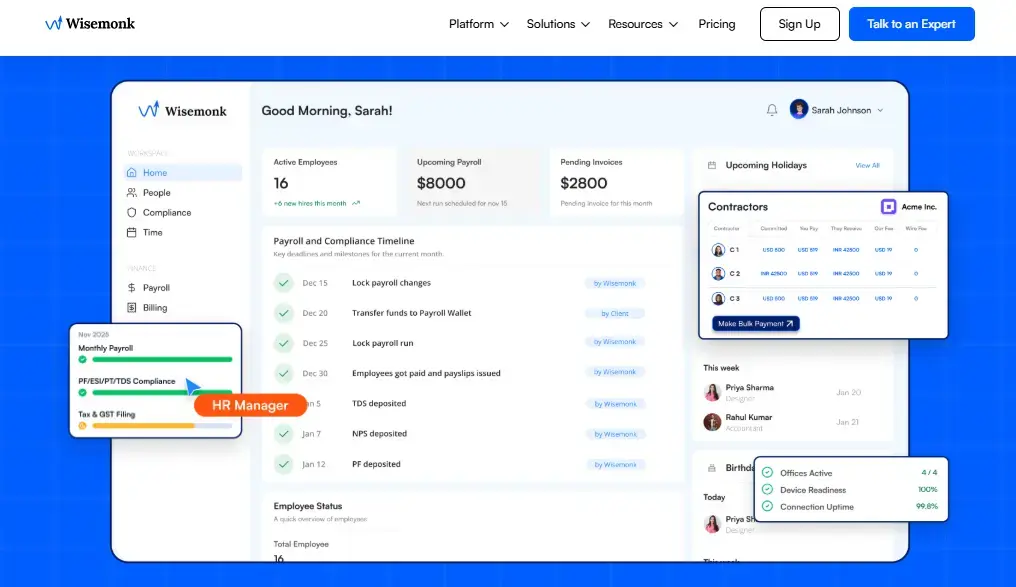
Wisemonk is a trusted India-specialist Employer of Record (EOR) that helps global companies hire, pay, and manage employees across markets, without setting up a local entity.
We specialize in helping US and UK companies build and manage distributed teams, handling everything from employment contracts and payroll processing to compliance and employee benefits.
We also offer comprehensive PEO services for businesses that already have a local entity and need hands-on support with HR functions, benefits administration, and regulatory compliance.
Here's how we support your business growth:
- Payroll processing: Accurate, on-time payroll compliant with local tax regulations, so you're protected from fines and errors
- Comprehensive employee benefits: From health insurance to retirement plans, we design competitive packages that help you attract and retain top talent
- Full compliance support: We manage 1,500+ labor compliance requirements, statutory filings, and employment contracts across our service markets, so you stay worry-free
- Recruitment and onboarding: We help you source, vet, and onboard talent in as little as 1-2 days, helping you scale your team faster than any traditional PEO setup
- Background verification: Every hire is screened and verified within 72 hours, ensuring SOC1 and SOC2 compliance for global companies
We built Wisemonk to make that easier. Transparent pricing starting at $99/month per employee. Industry-lowest FX markup at under 0.6%. No setup fees. No hidden costs.
Currently serving companies hiring in India, with expansion underway into key markets including the US and UK.
Still wondering what is a PEO and how it applies to your business? Wisemonk helps you navigate the right HR model from day one. Contact us today and let's get started.
Client Reviews:
"What stands out the most for me is the combination of advanced technology and excellent human support. WiseMonk’s interface is intuitive, the steps are logically arranged, and every requirement, from documentation to compliance checks, is communicated with clarity. What’s even better is that they don’t just automate processes, they explain them, which gives me confidence in every step we take."
- G2 Reviewer, Information Technology & Services, Rated 5/5 stars in G2
"Wisemonk shines with incredible Ease of Use and Ease of Implementation. Getting started and managing our global team has been remarkably simple, saving us significant time and effort. Their Customer Support is truly top-tier – always fast, knowledgeable, and genuinely helpful, providing a crucial safety net for our international operations. We use Wisemonk frequently because of its comprehensive Number of Features. It expertly handles everything from global payroll and compliance to benefits and equipment, all seamlessly integrated. The Ease of Integration with our existing systems has been a huge plus, ensuring smooth data flow and efficient operations across the board."
- Deepika M., Associate Talent Management, Small-Business, Rated 5/5 stars in G2
Frequently asked questions
What is a PEO?
A Professional Employer Organization (PEO) is a firm that enters into a co-employment relationship with a business to handle human resources and compliance. The PEO manages administrative duties while the client company maintains control over daily operations. It allows small businesses to access better benefits and ensures adherence to labor laws. This structure helps companies scale quickly.
How does a PEO work?
A PEO operates through a co-employment model where it becomes the administrative employer for tax and insurance purposes. The client company retains control over operations and employee performance. The PEO handles payroll processing, tax filings such as Tax Deducted at Source (TDS), and statutory contributions like Provident Fund (PF). This arrangement simplifies compliance for international firms.
Who is the employer in a PEO?
In a PEO arrangement, both the PEO and the client company share employer responsibilities through a co-employment model. The PEO acts as the administrative employer, managing payroll and tax reporting. The client company remains the worksite employer, directing the employee's daily tasks and business goals. This division of labor ensures that legal risks are managed while operations stay in-house.
What is the difference between a PEO and a payroll company?
A PEO provides comprehensive HR services including benefits administration and compliance, whereas a payroll company strictly processes payments. PEOs operate under a co-employment model, sharing legal liabilities with the client. Payroll companies do not assume employer status or provide HR management. PEOs typically offer access to group insurance and retirement plans that small firms cannot access.
What services do PEOs typically offer?
PEOs provide core HR services such as payroll processing, tax withholding, and benefits administration. They manage compliance with local labor laws, including Employee Provident Fund (PF) and Professional Tax (PT) contributions. Additional services often include workers' compensation insurance and performance management support. By bundling these tasks, PEOs reduce the administrative burden on companies.
What types of businesses can benefit from using a PEO?
Small to medium-sized enterprises and early-stage startups benefit most from using a PEO to scale without heavy administrative overhead. These organizations often lack internal HR departments and need assistance with regulatory compliance. International firms entering the Indian market use PEOs to hire local talent without establishing a legal entity. This model reduces risk and provides better benefits.
Does using a PEO mean losing control of my business?
Using a PEO does not result in a loss of control over workforce or business operations. The client company maintains full authority over hiring decisions, salary levels, and daily work assignments. The PEO only manages back-end administrative functions such as payroll, tax compliance, and benefit distribution. This partnership allows founders to focus on growth while outsourcing bureaucratic tasks.
.webp)




.png)







.webp)
.webp)
.webp)
.webp)
.webp)
.webp)
.webp)
.webp)
.webp)


.webp)
.webp)

.webp)

.webp)
%20in%20India.webp)




.webp)