%20(1).webp)
- ADP is the largest payroll and HR provider globally, but many businesses are switching due to complex quote-based pricing, inconsistent support, fragmented UX from acquired modules, hidden fees, and forced platform migrations as companies grow.
- The top ADP competitors include Gusto, OnPay, Wisemonk, QuickBooks Payroll, Rippling, Paychex, Paycor, Paycom, Remote, and Deel, each strong for different company sizes, payroll complexity levels, and global hiring needs.
- Choose by evaluating total 3-year cost of ownership, implementation timeline, integration ecosystem, scalability without forced migration, customer support quality across G2 and Capterra reviews, and security certifications (ISO 27001, SOC 2, data encryption).
- Avoid costly mistakes by skipping parallel payroll testing, rushing data migration, choosing on sticker price alone, ignoring W-2 filing handoff between providers, neglecting multi-state compliance needs, and failing to communicate the transition clearly to employees.
Need help with managing payroll in India? Reach out to us today!
Discover how Wisemonk creates impactful and reliable content.
Looking for reliable ADP alternatives that better fit your business needs? Whether you're a small business owner frustrated with ADP's pricing structure or an HR team seeking simpler payroll processing, finding the right payroll software can transform how you manage employee data and run payroll.
Many companies discover that ADP's features don't align with their actual requirements, leading them to explore competitors offering better value, transparent pricing, or more intuitive interfaces.
This guide is for business owners, HR teams, and finance managers evaluating payroll providers to find a solution that handles everything from automated payroll calculations to tax filing without the complexity. In this guide, we'll walk you through the top 10 ADP competitors, real user experiences, feature comparisons, and exactly what to look for when choosing your next payroll solution.
What is ADP and why do companies look for alternatives?[toc=What is ADP]
ADP is the largest payroll and HR provider in the world, with over 75 years in the business. More than 1.1 million clients across 140+ countries rely on ADP for payroll, HR, benefits, compliance, and talent management. It processes payroll for roughly 1 in 6 US workers.
The product lineup breaks into three tiers: RUN Powered by ADP serves over 900,000 small businesses with simple payroll processing, automated tax filings, and basic HR tools.
ADP Workforce Now is the mid-market suite covering payroll, benefits administration, talent management, and time tracking. ADP Vantage HCM handles enterprise-scale global payroll and workforce management.
On G2, the ratings tell an interesting story:
RUN scores well, but the ratings drop as you move into the more complex products. And that's where the frustration starts.
Why Companies Search for ADP Alternatives
- Pricing opacity: ADP uses quote-based pricing, making it difficult to compare costs against other payroll providers. Implementation fees, per-run charges, and tax filing add-ons often push the final bill well beyond the original quote.
- Fragmented UX: Users report the platform feels clunky, with too many screens, too many clicks, and limited modern UX. The forced migration from RUN to Workforce Now at around 50 employees feels like switching products entirely.
- Support inconsistency: Some cases resolve quickly, but others require multiple follow-ups, and support availability depends heavily on plan and region.
- Overkill for smaller teams: If you just need to pay employees, handle payroll tax, run direct deposit, and let your team access pay stubs, ADP's enterprise-grade complexity is more than most small businesses need.
ADP is a proven payroll provider. But proven doesn't mean right for everyone. The rest of this guide helps you figure out whether switching makes sense, and if it does, which alternative fits your situation best.
Should you actually switch from ADP?[toc=When to Switch]
Before jumping into ADP alternatives, it's worth asking: is ADP actually the problem?
Sometimes companies blame their payroll software when the real issue is an internal process gap, insufficient training, or being on the wrong ADP plan tier.
Switching payroll providers is not a small decision. ADP's implementation fees typically run 10 to 20% of annual software costs, and most competitors charge similar setup fees. Add in 2 to 12 weeks of implementation time, the risk of payroll disruption, and the headache of migrating employee data, tax filing history, and benefits enrollment, and you're looking at a real cost.
Signs It's NOT ADP's Fault
- You're on the wrong plan tier (RUN when you need Workforce Now, or vice versa)
- Your team hasn't been properly trained on the platform
- Internal payroll processes are messy regardless of the tool
- You need features that exist in ADP but haven't been activated
Clear Signals It's Time to Switch
- Hidden fees keep stacking up: ADP may charge separately for tax filing, year-end reporting, implementation (around $2,000), and benefits administration, with different rates for employees on payroll versus those needed just for reporting. If your total cost is consistently 30 to 50% above what you were quoted, that's a pattern.
- Support response times are unacceptable: If you're waiting 24 to 48 hours for critical payroll issues and can't get a dedicated rep, that's a legitimate reason to leave.
- The platform is overkill: If your 20-person team is paying for enterprise-grade HR software just to run direct deposit and manage payroll tax, you're overspending on features you'll never use.
- You've outgrown it the other way: If you need modern integrations, automated workflows, or a unified HR and IT platform, and ADP's fragmented modules aren't cutting it, that's a valid trigger too.
When ADP Is Still Your Best Option
Don't switch if you need global payroll across 50+ countries (ADP operates in 140+), have complex multi-state compliance requirements that ADP already handles well, rely on ADP's PEO services (TotalSource) for large-group health insurance, or have deep legacy system integrations that would be expensive to replicate.
The point is simple: switch because of a real, measurable problem, not frustration from a bad week.
What are the top ADP competitors in 2026?[toc=10 ADP Competitors]
The top ADP competitors include Gusto, OnPay, QuickBooks Payroll, Rippling, Paychex, Paycor, Remote, Deel, Wisemonk, and Paycom. Each one targets a specific gap in ADP's offering, whether that's pricing transparency, modern automation, global payroll, or dedicated support for specific regions.
Best for Small Businesses (1-50 Employees)
1. Gusto
Best for small businesses that want payroll, HR, and benefits in one clean platform. As of March 2026, the Simple plan starts at $49/month + $6/employee, Plus runs $80/month + $12/employee, and Premium costs $180/month + $22/employee. All plans include unlimited payroll runs and automated tax filings.
Why over ADP: Transparent pricing, 2-week setup vs. ADP's 4-8 weeks, and no forced platform migration as you scale.
Limitation: Lowest-tier plan doesn't include multi-state payroll or next-day direct deposit.
2. OnPay
Best for budget-conscious small businesses wanting one flat plan with zero surprises. Pricing is $49/month + $6/person with no hidden fees, and that single plan includes full-service payroll, HR tools, and benefits administration across all 50 states. Averages 4.8/5 across 700+ reviews on Capterra, G2, and Trustpilot.
Why over ADP: Simplest pricing in the market. Multi-state payroll included at no extra cost.
Limitation: No employer-side mobile app and fewer third-party integrations.
3. QuickBooks Payroll
Best for businesses already running QuickBooks for accounting. The core plan starts at $50/month per employee. The native QuickBooks Online integration means payroll syncs directly with your books, zero manual reconciliation needed.
Why over ADP: Unmatched accounting integration for QuickBooks users. Simple payroll processing for small teams.
Limitation: HR features are thin compared to Gusto or Rippling.
Best for Mid-Market Companies (50-1,000 Employees)
4. Rippling
Best for growth-stage companies that want HR, IT, and finance unified in one platform. Pricing starts at $8/employee/month for the core platform (Rippling Unity) plus a $35 monthly base fee, with most businesses paying $25-$50/employee/month after adding payroll and HR modules. Modular pricing means you only pay for what you use.
Why over ADP: Modern automation engine with 600+ integrations. Onboarding triggers app access, device setup, and payroll in one workflow. No fragmented modules.
Limitation: Pricing lacks transparency since you need a custom quote, and costs add up quickly with advanced modules.
5. Paychex Flex
Best for mid-market companies that want a legacy-grade payroll provider with 24/7 human support. Paychex uses custom pricing based on company size and services selected. On G2, Paychex holds a 4.1/5 rating.
Why over ADP: 24/7 phone, email, and chat support across all tiers. Faster onboarding (48 hours with the Select and Pro plans). Similar reliability with better service accessibility.
Limitation: Add-on costs for training, benefits administration, and time tracking can stack up quickly.
6. Paycor
Best for mid-market HR teams that want recruiting and performance management baked into their payroll platform. Paycor has grown through acquisitions (Newton ATS, 7Geese performance tools) to build a broader HCM suite. Custom pricing based on company size.
Why over ADP: More modern talent management tools for companies focused on the entire employee lifecycle. Cleaner UX than ADP Workforce Now.
Limitation: Growth-by-acquisition means some modules still feel disjointed. Paycor holds a 3.9/5 on G2 (1,273 reviews), lower than several competitors.
7. Paycom
Best for mid-market companies that want everything built in one system, not bolted together through acquisitions. Paycom's entire platform is internally built, creating a unified experience from payroll processing to talent management to employee self-service. Their employee-driven payroll model (Beti) lets employees verify and approve their own paychecks before payday.
Why over ADP: Single codebase means no fragmented UX. The Beti feature reduces payroll errors by putting verification in employees' hands.
Limitation: Closed ecosystem with limited third-party integrations. Paycom has a 4.3/5 G2 rating (1,764 reviews).
Best for Global and Distributed Teams
8. Wisemonk
Best for US,UK and foreign companies specifically hiring in India. Wisemonk pricing starts at $99/employee/month, making it one of the most cost-effective EOR options for India hiring. Wisemonk manages 2,000+ employees across India with $20M+ in payroll processed, and holds a 4.8/5 rating on G2.
Why over ADP: ADP's global payroll covers India, but it's enterprise-priced and treats India as one of 140+ countries. Wisemonk is India-only, which means deeper expertise in Indian labor law, state-level compliance, tax optimization to increase employee take-home pay, and dedicated HR managers for every client's team.
Limitation: India-only. If you need payroll across multiple countries, you'll need Wisemonk alongside a broader global provider.
9. Remote
Best for companies hiring full-time employees internationally with a compliance-first approach. EOR pricing starts at $599/employee/month on an annual commitment, or $699 on a monthly basis. Contractor management starts at $29/contractor/month. Remote owns 100% of its legal entities across 90+ countries, no third-party middlemen.
Why over ADP: Far simpler and more affordable than ADP's enterprise-priced global payroll for SMBs. Transparent flat-rate pricing with IP protection (IP Guard) included.
Limitation: More expensive than budget EOR providers. Basic reporting capabilities.
10. Deel
Best for fast-scaling companies that need contractor + employee payroll across 150+ countries. Deel charges $599/employee/month for EOR services and $49/month for contractors
The platform combines global payroll, compliance automation, and HR tools in a single system. Over 35,000 companies use Deel globally.
Why over ADP: Faster global setup, better contractor management, and more modern UX than ADP's global payroll product.
Limitation: Platform complexity can be overwhelming for smaller teams. Premium pricing.
How do ADP competitors compare on pricing?[toc=Pricing Comparison]
ADP's biggest pain point for most businesses is pricing transparency. ADP uses quote-based pricing across all its products, which makes it nearly impossible to compare costs upfront.
Here's what the actual numbers look like:
ADP's Pricing Breakdown
ADP RUN's Essential Plan starts at roughly $79/month + $4/employee, based on user reports. ADP Workforce Now runs $23-30/employee/month for software-only, and $30-50/employee/month with outsourced services. On top of that, implementation fees are typically 10-20% of annual software costs (so $10,000-$20,000 on a $100,000 annual purchase).
The hidden costs are where it gets expensive. ADP charges extra for year-end tax filings (roughly $55 + $6.50 per W-2), per-payroll-run fees for off-cycle payments, and time tracking add-ons (estimated $100/month for 10 employees). These aren't always disclosed during the sales conversation.
Transparent Pricing Alternatives
Here's how the competitors stack up:
For global payroll, ADP's 140+ country infrastructure is enterprise-priced and overkill for SMBs. Remote and Deel offer flat-rate global EOR at $599/employee/month.
And if you're specifically hiring in India, Wisemonk EOR at $99/employee/month is a fraction of what ADP or any global EOR charges, with deeper India-specific compliance expertise included.
How do you successfully switch from ADP to a competitor?[toc=Key Considerations]
Switching payroll providers sounds scary, but with the right timeline and checklist, it's straightforward. The biggest mistakes happen when companies rush the process or skip parallel testing.
Here's how to do it right!
Timeline: Plan for 30-60 Days Minimum
You can switch payroll providers at any time, not just at year-end. That said, aligning your switch with the start of a quarter reduces tax filing complexity. Gusto claims most businesses can make the move in less than 7 days, but that's for simple setups. For mid-market companies with benefits, multi-state payroll, and integrations, plan for 4-8 weeks.
Switching Checklist
60 days before switch:
- Review your ADP contract for cancellation terms and notice requirements. ADP contracts typically auto-renew and require 90 days written notice to terminate, so check your specific agreement early.
- Select your new provider and negotiate pricing. Get the full cost breakdown in writing, including implementation fees, per-run charges, and add-ons.
- Assign an internal project lead. For small businesses, this can be one person. For 100+ employees, involve HR, finance, and IT.
30 days before switch:
- Export all data from ADP: employee records, YTD payroll totals, tax filing history, benefits enrollment data, and direct deposit information.
- Begin parallel system setup with your new provider. Platforms like Gusto, OnPay, and Paychex offer white-glove migration support that imports your payroll history.
- Notify employees about the upcoming change, including what they need to do (if anything) and when they'll access the new employee portal.
2 weeks before switch:
- Run a parallel test payroll to compare outcomes and confirm accuracy. This is the step most companies skip, and it's the one that prevents payroll errors on day one.
- Verify benefits enrollment transferred correctly. Confirm tax registrations are active in all states you operate in.
- Test integrations with your accounting software, time tracking tools, and any other systems that connect to payroll.
Switch week:
- Run your final payroll through ADP. Then run your first payroll through the new provider.
- Reconcile both to make sure employee data, tax calculations, and deductions match.
- Clarify with ADP whether they'll file W-2s at year-end or if your new provider handles it. If you don't clarify, duplicate W-2s may be filed, resulting in IRS notices.
Mid-Year Switching: What to Know
You can switch at any point during the year, and full-service payroll providers will help you migrate your tax history and process taxes going forward. The key is making sure your YTD payroll data transfers accurately so that W-2s and quarterly filings at year-end reflect the combined totals from both providers. Quarter-end is the cleanest cutover point, but it's not mandatory.
What do users say about switching from ADP?[toc=User Reviews]
Across G2, Capterra, and other review platforms, the feedback from companies that have switched from ADP follows a clear pattern.
Here's what actual users report:
Why They Left
The three most common reasons are consistent across review platforms:
- Support frustrations: One Capterra reviewer noted: "customer support has often been difficult to reach, and when issues arise, resolution times are extremely long" [Capterra]. Another long-time user reported having three different case managers in six months [Capterra], making it impossible to build a consistent support relationship. This is the single most cited reason for switching.
- Pricing surprises: Multiple reviewers flag that advanced HR tools and integrations like time tracking and benefits management require paid add-ons, which increase costs beyond the initial quote [Capterra]. Companies often discover the true total cost only after they're already committed.
- Complexity mismatch: Users describe ADP Workforce Now as "overly complex in practice, making simple tasks take far more time than they should" [Capterra]. For smaller teams especially, the platform's depth becomes a burden rather than a benefit. One RUN user put it simply: "The site is not very intuitive for finding information I need" [Capterra].
What They Found After Switching
Poor user experience is the number one reason companies switch payroll providers within the first year. The companies that report the highest satisfaction after leaving ADP are typically those that moved to a provider matched to their actual size and complexity, not just the one with the most features.
Common Regrets
Switching isn't always smooth. The most frequently mentioned challenges include data migration hiccups (especially YTD payroll totals and tax history), a short learning curve on the new platform, and occasional feature gaps for companies with complex, multi-state compliance needs. Running parallel payroll for at least one cycle catches most discrepancies before they become problems.
What should you look for when evaluating ADP alternatives?[toc=What to Look For]
Before you demo a single product, get clear on what actually matters for your business. Most companies regret their payroll switch not because they picked the wrong tool, but because they didn't define what "right" looked like upfront.
Capterra's 2026 Software Buying Trends survey found that 60% of HR software buyers experienced at least one implementation disruption, and over half felt disappointment with their purchase.
Here's the evaluation framework that prevents that:
1. Total Cost of Ownership (Not Just the Per-Employee Rate)
Ask for the full cost breakdown in writing before signing anything. That means base fee, per-employee charge, implementation fees, per-payroll-run fees, add-on costs for time tracking, benefits administration, and year-end tax form processing.
Compare 3-year total cost, not monthly sticker price. ADP's quote-based model makes this especially hard, which is exactly why transparent-pricing providers like Gusto and OnPay have an advantage here.
2. Implementation Timeline and Migration Support
Gusto and BambooHR typically take 2-4 weeks to implement, Rippling takes 4-8 weeks, and enterprise platforms like Workday can take 6-12 months.
Ask your shortlisted providers: Do they offer white-glove data migration? Will they import YTD payroll data and tax filing history? Do they run a parallel payroll test before go-live?
3. Integration Ecosystem
Your payroll software doesn't live in isolation. It needs to connect with your accounting software (QuickBooks, Xero), time tracking tools, benefits providers, and applicant tracking system. Check how many native integrations exist and whether API access is available for custom connections. Rippling leads here with 600+ integrations. Gusto connects with 130+ tools. ADP has opened up its APIs recently but still lags behind modern platforms.
4. Scalability Without Forced Migration
This is one of ADP's biggest weaknesses. You start on RUN, then get forced onto Workforce Now at around 50 employees, which feels like switching to a completely different product.
Ask any alternative: can it scale from your current size to 3x your headcount without requiring a platform change? Gusto, Rippling, and Paycom handle this well. Some smaller providers may not.
5. Customer Support Quality
Evaluate support before buying. Check what response times look like, whether support is tiered by pricing or available equally across all plans, and review third-party sites for unfiltered support experiences.
Paychex offers 24/7 support across all tiers. Gusto and OnPay get high marks for support quality. Rippling's support is chat-first, with phone support only for 150+ employee companies.
6. Security and Compliance
Look for data encryption standards, compliance certifications (ISO 27001 is the gold standard), role-based access controls, and regular security audits.
Your payroll system holds Social Security numbers, bank details, and salary data. This isn't optional. Also confirm the platform handles automated tax updates for all jurisdictions you operate in, not just federal.
7. Trial and Demo Best Practices
Don't just watch a sales demo. Run a test payroll with your actual employee data. Verify tax calculations match what you expect. Test the employee self-service portal (can your team access pay stubs, update direct deposit info, view benefits?). And test at least one integration with your accounting software before committing.
The company that checks the most boxes on this list isn't always the right pick. The right pick is the one that solves your specific pain point (pricing, support, complexity, global needs) without introducing new ones.
Get Started With Wisemonk EOR[toc=Choose Wisemonk EOR]
Wisemonk is an India-specialist Employer of Record (EOR) platform designed for global companies that want to hire, pay, and manage talent in India without setting up a legal entity. Wisemonk goes deep into India’s compliance, payroll, benefits, and statutory frameworks, an area where most global HCM and EOR platforms struggle with accuracy or nuance.
Additionally, Wisemonk manages $20M+ in payroll, supports 300+ global companies, and oversees HR operations for more than 2,000 employees across India.
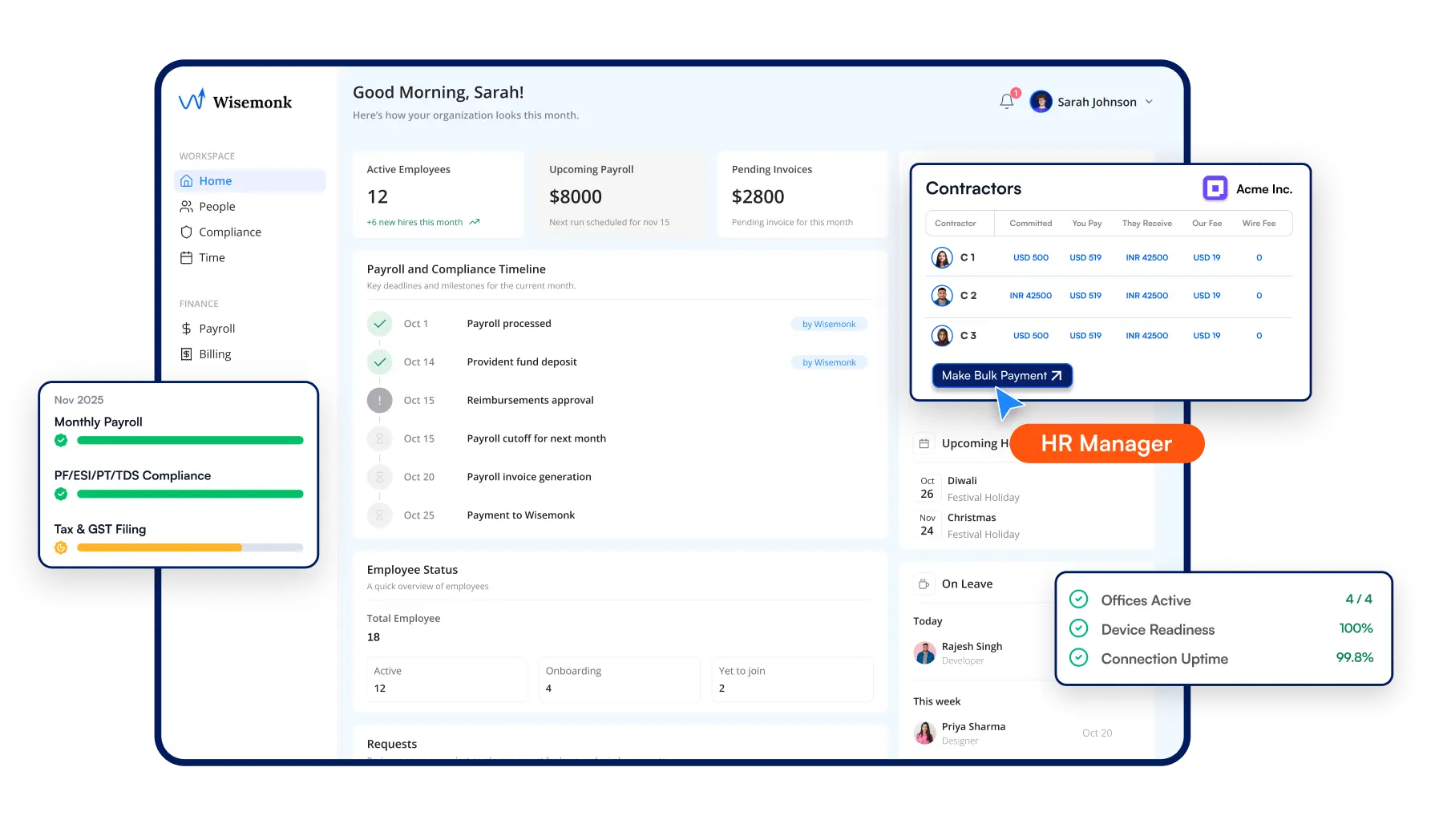
Here’s what you get with Wisemonk EOR:
- Fast, compliant hiring: Onboard employees in days, not months, with legally compliant contracts and smooth setup across regions.
- Accurate payroll and tax management: We run payroll, handle taxes, and ensure 100% statutory compliance for employees and contractors.
- Locally competitive benefits: Offer healthcare, leave policies, and perks that meet local standards and attract top talent.
- Equipment procurement and remote team enablement: Ensure your distributed teams have the right tools, devices, and support from day one, fully managed by us.
- Dedicated HR support: Our HR experts (dedicated recruiter) manage employee engagement, performance queries, and day-to-day operations, keeping your workforce productive and satisfied.
- End-to-end compliance and risk protection: Stay safeguarded from labor law issues, misclassification risks, and regulatory pitfalls with our in-depth local expertise.
While India remains our core strength, Wisemonk now supports expansion into the United States, the United Kingdom , and other major markets, giving you a single trusted partner for all your global hiring needs.
For companies using ADP or evaluating ADP alternatives, Wisemonk offers a focused, high-accuracy solution where India acts as a critical talent hub, giving you both confidence and speed in a market that demands precision.
Ready to streamline hiring and payroll in India? Contact us today!
Frequently asked questions
What is the best alternative to ADP?
The best ADP alternative depends on your business size and needs. Gusto ranks #1 for small businesses with transparent pricing and modern interface. Rippling excels for high-growth companies needing unified HR, IT, and finance. Paychex suits mid-sized businesses requiring enterprise-grade features. Wisemonk is ideal for US companies building teams in India with fully managed compliance.
Is Gusto better than ADP?
For small businesses, yes. Gusto is easier to use, more affordable, and offers transparent pricing starting at $40/month plus $6 per employee. Gusto received 4.5/5 on G2 versus ADP's 4.1/5. However, ADP is better for enterprises needing global payroll in 140+ countries and extensive customization options.
Are Paycom and ADP competitors?
Yes, Paycom and ADP are direct competitors in the payroll and HR software market. Both offer comprehensive payroll processing, HR management, and compliance solutions for businesses of various sizes, with some differences in customization and target markets.
Is Workday or ADP better?
The choice between Workday and ADP depends on your business needs. ADP is often preferred by small to mid-sized businesses for its payroll expertise and modular solutions, while Workday is favored by larger enterprises seeking advanced analytics, unified HR and finance management, and greater customization.
Who is a competitor of ADP?
Major competitors of ADP include Paychex, Gusto, Rippling, Workday, Paycom, and TriNet, all offering payroll and HR solutions for businesses of various sizes.
Is Paychex better than ADP?
Paychex is better for small to mid-sized businesses seeking transparent pricing and dedicated support. Both received similar G2 ratings (Paychex 4.1/5, ADP 4.1/5). ADP is preferred for global payroll and large enterprises, while Paychex excels at personalized service and faster implementation.
What can ADP be compared to?
ADP can be compared to other leading payroll and HR platforms such as Paychex, Gusto, Rippling, Workday, and Paycom, which all provide similar core services like payroll processing, benefits administration, and compliance management.
.webp)




.png)







.webp)
.webp)

.webp)
.webp)
.webp)
.webp)

.webp)
.webp)
.webp)



.webp)
.webp)

.webp)

.webp)
%20in%20India.webp)




.webp)