_%202025%20Complete%20Guide_Blog_2.webp)
- An employer of record (EOR) is a third-party organization that legally employs workers on your behalf, handling contracts, payroll, and compliance while you retain full control over their day-to-day work.
- An EOR onboards employees in 2 to 5 days, managing contracts, payroll, tax filings, benefits, onboarding, offboarding, and HR inquiries so your team can hire globally without administrative overhead.
- Companies use an EOR to skip entity setup, access global talent, stay locally compliant, and reduce HR workload. Most report a 50 to 70% drop in administrative burden after switching to an EOR model.
- EOR pricing ranges from $99 to $1,200 per employee per month depending on the country and services included. At 10 to 15 employees in one market, setting up your own entity may become more cost-effective.
Need help with Employer of Record? Reach out to us today!
Discover how Wisemonk creates impactful and reliable content.
What if you could hire top talent anywhere in the world without setting up a legal entity, managing local payroll, or decoding foreign employment laws?
That's exactly what an employer of record (EOR) makes possible. An EOR acts as the legal employer for your international workforce, handling compliance, contracts, and payroll while you stay in full control of the work. Having helped 300+ companies hire and pay talent across multiple countries, we know how much complexity a good EOR partnership removes from the equation.
This guide covers everything you need to know about employer of record services, what an EOR is, how it works, the benefits, risks, costs, why companies use one, and the alternatives worth considering.
What is an employer of record?[toc=Employer Of Record]
An employer of record (EOR) is a third-party organization that legally employs workers on your behalf. The EOR handles employment contracts, payroll, taxes, benefits, and compliance with local labor laws, while you retain full control over your team's day-to-day work, performance, and culture.
Think of it as a distinction between the formal employer (the EOR, on paper) and the practical employer (you, in reality).
An EOR can operate domestically or across borders, but international hiring is where it delivers the most value, letting you bring on employees in foreign countries without setting up a legal entity in each one.
The global EOR market was valued at $4.42 billion in 2023 and is projected to reach $8.59 billion by 2030, growing at 6.8% annually, a trajectory largely driven by the remote work explosion accelerated by COVID-19. (Verified Market Research)
How does the employer of record relationship work?
The EOR model involves three parties:
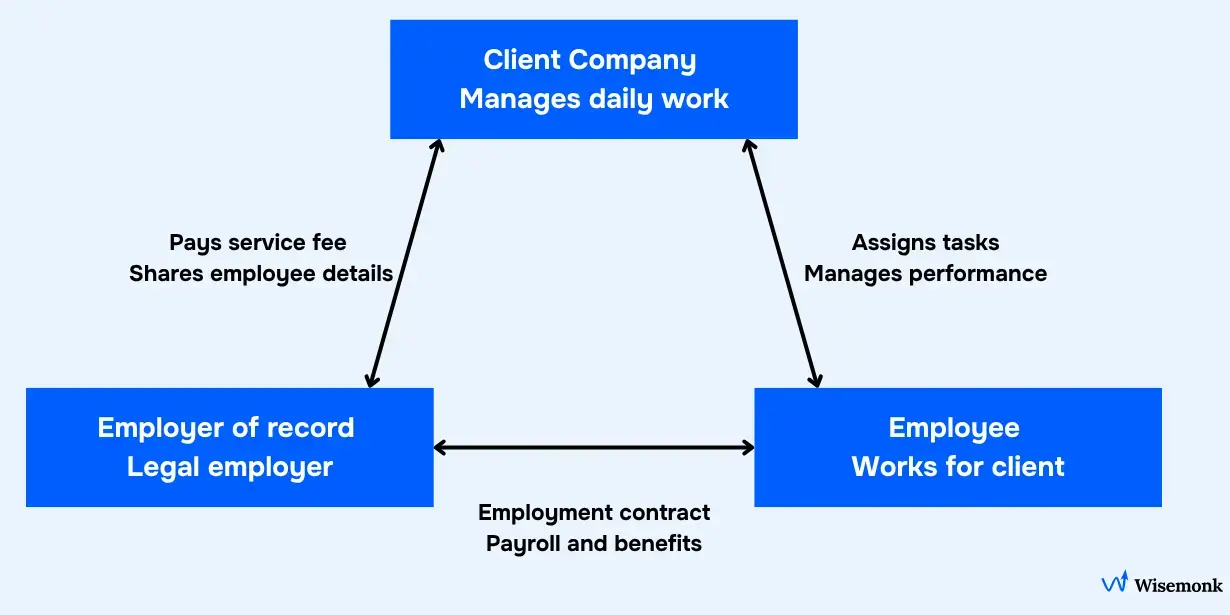
- The client company: Identifies the candidate, defines the role, and manages day-to-day work.
- The EOR: Creates the employment contract, runs payroll, and ensures local compliance.
- The employee: Legally employed by the EOR but operationally reporting to the client.
This triangular structure is what makes global hiring without an entity legally possible.
How does an employer of record work?[toc=How It Works]
Having helped 300+ companies navigate international hiring, payroll, and compliance, here is exactly how the EOR process works in practice.
An EOR becomes the legal employer of your workers on paper while you manage their daily work and performance. The process typically takes 5 to 10 business days from start to hire-ready.
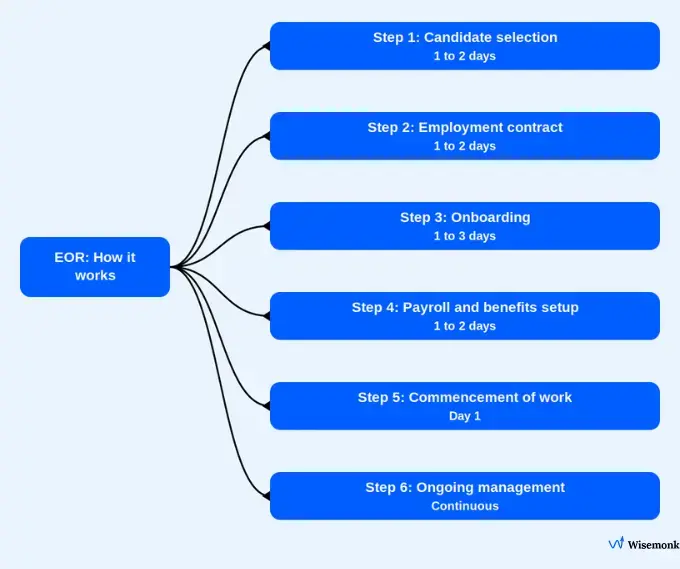
Step 1: You identify and select your candidate (1 to 2 days)
Interview and select the talent you want to hire, just like any normal hiring process. You retain full control over who joins your team, the EOR plays no role in candidate selection. Once you have your candidate, you share their details, agreed compensation, and start date with the EOR to kick off the process.
Step 2: EOR drafts a locally compliant employment contract (1 to 2 days)
The EOR creates an employment agreement that meets the legal requirements of the employee's country, covering notice periods, statutory benefits, termination clauses, and local labor law obligations. This is one of the most critical steps since a non-compliant contract either becomes void or defaults to the most employee-favorable interpretation under local law. The EOR ensures every clause holds up legally before the employee signs.
Step 3: EOR conducts onboarding (1 to 3 days)
The EOR handles background checks, right-to-work verification, and all required documentation before the employee's first day. This includes collecting tax identification details, bank account information for payroll, and any country-specific forms required by local authorities. The EOR ensures the employee is fully set up on the right side of the law before they start.
Step 4: EOR sets up payroll and benefits (1 to 2 days)
Payroll is configured, benefits are enrolled, and tax registrations are completed in the employee's jurisdiction. This includes setting up statutory contributions such as provident fund, social security, or pension depending on the country, as well as any supplemental benefits your team offers. The employee receives their first payslip from the EOR, not from your company.
Step 5: Employee begins work (Day 1)
The employee starts working with your team. They report to you operationally, follow your processes, and integrate into your culture, but are legally employed by the EOR. It is worth communicating this clearly to new hires from day one so they understand who to contact for payroll questions versus work-related matters.
Step 6: Ongoing management
The EOR processes monthly payroll, manages tax filings, handles HR inquiries, and keeps you compliant as laws change. They also track regulatory updates in the employee's country and adjust contracts or contributions automatically when required. When the time comes, the EOR manages offboarding as well, including final payments, termination compliance, and notice period requirements, so you are never exposed to legal risk at the end of an employment relationship.
What does the employee experience look like?
For the employee, the experience looks like this:
- Employment contract: Signed with the EOR, not your company.
- Payslips and tax documents: Issued by the EOR.
- Benefits: Enrolled and administered through the EOR.
- HR and payroll questions: Directed to the EOR.
- Day-to-day work: Fully managed by you.
One thing worth communicating clearly to new hires: the EOR is their legal employer for administrative purposes only. Their actual work, growth, and team experience all come from you. Without that clarity, some employees feel a disconnect early on.
The steps above give you the overview. For a deeper look at what happens behind the scenes at each stage, including payroll cycles, compliance updates, and offboarding, see our full employer of record process guide.
Now that you know how the process works, here is a closer look at the specific employer of record services an EOR handles on your behalf.
What services does an employer of record provide?[toc=EOR Services]
An employer of record handles all legal employer responsibilities so you can hire employees globally without setting up local entities. You keep full control over your team's daily work and performance, the EOR takes care of the compliance, administration, and legal obligations.
Here is what employer of record services typically cover:
- Employment contracts: Drafts and maintains locally compliant, jurisdiction-specific employment agreements covering notice periods, termination clauses, and statutory entitlements.
- Payroll processing: Manages salary calculations, multi-currency payments, tax withholding, and statutory contributions, ensuring employees are paid accurately and on time in their local currency.
- Tax compliance: Handles all tax withholding, remittance, filings, and social security contributions in the employee's country.
- Benefits administration: Enrolls and administers both statutory benefits (mandatory by law) and supplemental benefits such as health insurance and retirement plans.
- HR compliance: Ensures adherence to local labor laws, termination procedures, and notice period requirements as regulations change.
- Onboarding and offboarding: Manages all documentation, background checks, and legal requirements when bringing employees on and off your team.
- Work permits and visa support: Assists with work authorization where applicable, particularly for cross-border hires.
- Employee support: Acts as the first point of contact for payroll queries, benefits questions, and HR inquiries on behalf of your team.
Understanding the full scope of employer of record services makes it easier to see why so many companies choose an employer of record over other hiring options.
Why do companies use an employer of record?[toc=Why Companies Use EOR]
Companies turn to an employer of record for one core reason: it removes the legal, administrative, and compliance complexity of hiring across borders, so they can focus on building their team and their business.
Here is what specifically drives that decision:
- No entity setup required: Hiring through an EOR means skipping the months-long process of registering a legal entity in a foreign country.
- Faster onboarding: Employees can be onboarded in days rather than the months it takes to establish a local entity.
- Access to global talent: EORs remove geographic restrictions, letting you hire the best person for the role regardless of where they live.
- Market testing with low risk: Companies use EORs to test new markets with a small team before committing to permanent infrastructure.
- Local compliance handled: EORs stay current with complex and frequently changing local labor laws, so you do not have to.
- Reduced HR burden: Internal HR teams are freed from managing foreign payroll, tax filings, and benefits administration.
- Legal and tax risk mitigation: Compliance liability transfers to the EOR, reducing your exposure to penalties and violations.
When should you use an employer of record?
An employer of record makes the most sense when:
- You want to hire in a market where you have no registered legal entity or physical office.
- You are bringing on 1 to 10 employees in a market where full entity setup is not yet justified.
- You want to validate demand or build a team before making a long-term infrastructure commitment.
- You are managing remote workers spread across several countries with different labor law requirements.
- You need people onboarded quickly for a project-based or seasonal surge.
- Your internal team does not have the knowledge to navigate foreign employment law on their own.
When should you NOT use an employer of record?
An EOR is not always the right fit. Consider alternatives when:
- Your team in one country exceeds 10 to 15 employees, as setting up your own entity often becomes more cost-effective than ongoing EOR fees.
- You need a permanent, large-scale presence where long-term operations with big teams are better served by a local entity.
- You require complete control over HR policies and benefits, since EORs operate within their own frameworks which limits customization.
- Your industry has specific entity requirements that mandate a locally registered entity regardless of team size.
- You already have existing local operations where an EOR adds cost without adding value.
Understanding why companies use an employer of record naturally leads to the question of what specific employer of record benefits you can expect for your business.
What are the benefits of using an employer of record?[toc=Benefits Of Using EOR]
Having onboarded over 2,000 employees across multiple countries, we have seen firsthand how working with an employer of record removes the biggest barriers to hiring globally. Speed, cost, and compliance complexity are no longer blockers.
Here is what that looks like in practice:
- Speed to market: Hire employees in a new country in 2 to 5 days instead of waiting 4 to 8 months to set up a local entity.
- Significant cost savings: Avoid entity setup costs that typically run between $10,000 and $50,000 per country, plus ongoing legal and accounting infrastructure expenses.
- Compliance liability transfer: The EOR assumes legal responsibility for employment compliance, reducing your exposure to penalties and labor law violations.
- Access to global talent: Hire the best candidates regardless of where they are located, without geographic or visa restrictions.
- Reduced HR workload: Companies typically see a 50 to 70% reduction in HR administrative work by outsourcing payroll, tax filings, and benefits administration to an EOR.
- Better benefits packages: EORs leverage economies of scale to offer competitive statutory and supplemental benefits that smaller companies could not access independently.
- Market testing with low commitment: Test a new market with a small team before making the full infrastructure investment.
- Flexibility to scale: Add or reduce headcount across countries without the constraints of managing multiple local entities.
These employer of record benefits make EOR services particularly valuable for companies scaling internationally without the overhead of setting up local entities in every market.
For a deeper breakdown of each benefit above, with real numbers and honest trade-offs, read our complete EOR benefits guide.
What are the risks and challenges of employer of record services?[toc=Risks & Challenges of EOR]
An employer of record simplifies global hiring, but it is not without limitations. Here is an honest look at the risks and challenges to factor into your decision:
- Higher per-employee cost: EOR providers typically charge a 15 to 30% markup over direct employment costs. At 10 to 15 employees in a single country, setting up your own entity often becomes more cost-effective than ongoing EOR fees.
- Hidden costs: Watch for FX conversion spreads, payment processing delays, limited benefits options, and termination fees that are not always disclosed upfront.
- Less control over HR policies and benefits: EORs operate within their own frameworks, limiting your ability to customize benefits packages or employment terms the way a direct entity would allow.
- Permanent establishment risk: If your employee regularly signs contracts, generates revenue, or makes key business decisions on your behalf, tax authorities may still deem you have a taxable presence in that country, even with an EOR in place. Dell's PE case in Spain is a well-known example of how this plays out.
- Employee experience gaps: Employees legally employed by a third party can feel a disconnect around benefits, HR support, and company culture if the arrangement is not communicated clearly from day one.
- Vendor dependency and quality variation: EOR quality varies significantly across providers. A weak provider creates more compliance risk than it solves, as seen in the Glovo case where poor employment structure management led to a €79 million fine.
- IP and data security: Working with an EOR means sharing sensitive employee and business information with a third party. Ensure your provider has robust data protection policies and contractual safeguards in place.
Understanding the compliance risks is one thing. Knowing exactly what employer of record compliance covers, who is ultimately responsible when things go wrong, and what questions to ask before signing is another. Read our complete employer of record compliance guide.
One question that comes up often at this stage is the employer of record vs PEO distinction, and which model is the right fit for your business.
What are alternatives to using an employer of record?[toc=EOR Alternatives]
If an EOR doesn't fit your needs, there are other ways to hire and manage employees internationally.
The right choice depends on your budget, timeline, and how much control you want.
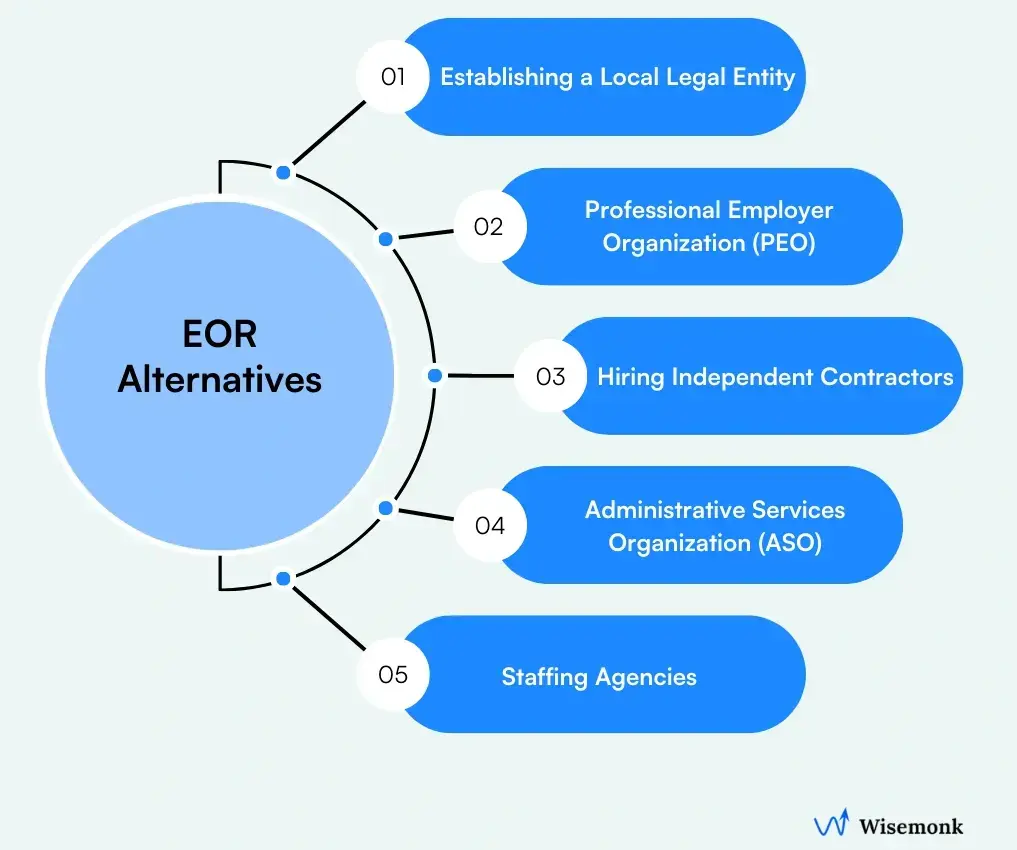
The primary options are:
- Establishing a Local Legal Entity
- Professional Employer Organization (PEO)
- Hiring Independent Contractors
- Administrative Services Organization (ASO)
- Staffing Agencies
Let's compare how each option stacks up against an EOR.
EOR vs. Setting Up Your Own Entity
Setting up a local entity gives you complete control but requires significant time and investment.
When to choose own entity: You're hiring 50+ people in one country for the long term and want full control over HR policies.
Read more: Employer of Record vs Own Entity
Employer of Record vs PEO
A PEO shares employer responsibilities with you, but you need an existing entity in the country.
When to choose PEO: You already have a legal entity and want help with HR admin but prefer to share control.
Read more: PEO vs. EOR Guide: Key Differences for Global Hiring
EOR vs. Independent Contractors
Contractors offer flexibility but come with misclassification risks if not managed correctly.
When to choose contractors: Short-term projects where you don't need ongoing employees or control over how work gets done.
Read more: Independent Contractor vs Employee 2026
EOR vs. ASO (Administrative Services Organization)
An ASO provides HR support without becoming the legal employer or sharing liability.
When to choose ASO: You have a local entity and want to outsource specific HR functions while keeping full control and responsibility.
Read more: PEO vs. ASO: Which HR Model is Right for U.S. SMBs?
EOR vs. Staffing Agency
Staffing agencies help you find talent but don't handle ongoing employment responsibilities.
When to choose staffing agency: You need temporary coverage or project-based staff and want help finding candidates quickly.
Read more: Employer of Record vs Staffing Agency: Key Differences
Each option serves different needs. An EOR is ideal when you want to hire internationally fast without entity setup, while alternatives work better when you have existing infrastructure or different employment models.
Which countries and industries commonly use employer of record services?[toc=EOR: Countries & Industries]
Employer of record services are used across every major hiring market, but they add the most value in countries where employment compliance is complex, frequently changing, or difficult to navigate without local expertise.
The most active EOR markets globally include:
- India: A high-growth talent market for technology, fintech, biotech, and engineering roles, with state-by-state compliance variation that makes EOR particularly valuable.
- United Kingdom: Strong demand for compliant contractor-to-employee conversions following IR35 reforms.
- Germany: Strict labor protections, works council requirements, and termination laws make EOR a popular choice for market entry.
- Netherlands: Popular European tech hub with complex benefit and pension obligations.
- Canada: Provincial variation in employment standards makes multi-province hiring complicated without local support.
- Australia: Fair Work Act compliance, superannuation obligations, and award rates drive EOR adoption.
- Brazil: One of the most complex labor markets globally, with CLT regulations making direct employment highly technical.
- Singapore: A gateway to Southeast Asia with strong IP protections and a business-friendly EOR environment.
Which industries use employer of record services most?
EOR adoption is highest in industries that rely on distributed, specialized, or internationally mobile talent:
- Technology: Remote-first engineering and product teams hiring across time zones without geographic restrictions.
- Healthcare and life sciences: Specialized talent is scarce and often located in specific markets, making cross-border hiring a necessity.
- Consulting and professional services: Project-based work across multiple countries where setting up entities is not cost-justified.
- Finance and fintech: Regulated environments where compliance expertise is critical and costly to build in-house.
- Manufacturing and supply chain: Operational teams in production markets where local employment law is complex.
Remote-first companies and venture-backed startups represent the fastest-growing EOR user segment, using the model to test international markets and build distributed teams before committing to permanent infrastructure.
How much does an employer of record cost?[toc=Cost of EOR]
Most employer of record companies charge using one of two pricing models:
- Flat fee: A fixed monthly rate per employee regardless of salary, typically ranging from $99 to $1,200 per employee per month depending on the country. This gives you predictable costs and easier budget planning.
- Percentage of payroll: A percentage of each employee's gross salary, typically between 3 and 15%. This can be cheaper for junior staff but gets expensive as salaries increase.
Here is what flat fee pricing looks like across key markets:
Cost varies based on the country, services included, employee headcount, contract length, and any additional services like visa support or equipment management. Always ask for a full fee breakdown including onboarding, offboarding, and currency conversion charges before signing.
For a complete breakdown of EOR pricing models, hidden costs, and a provider comparison, read our full EOR Pricing Guide 2026.
How to choose the right global Employer of Record?[toc=How to Choose Right EOR]
Understanding what is an employer of record is only half the equation, choosing the right one is where most companies get stuck. The right EOR should have local expertise, transparent pricing, and a proven track record in the countries where you plan to hire.
Key factors to evaluate:
- Owned legal entities in your target countries, not third-party partners
- Deep knowledge of local employment laws and regulatory compliance
- Transparent pricing with no hidden fees for setup or offboarding
- Platform that integrates seamlessly with your existing HR and payroll tools
- Dedicated support with local expertise in your time zones and languages
- Strong data security certifications like ISO 27001 and SOC 2
- Proven reputation with client reviews and case studies from similar companies
- Scalable solutions that grow with your team across multiple countries
Request demos from multiple providers and ask how they'd handle your specific hiring scenarios before making a decision.
For deeper insights into selecting the right EOR, check out this detailed guide on "How to choose an Employer of Record" & check this guide to know more about the "10 best Employer of Record companies"
Wisemonk: Your Trusted EOR Partner for Global Hiring[toc=Why Choose Wisemonk EOR]
Wisemonk is a leading Employer of Record (EOR) helping global companies hire, pay, and manage employees in India, without the hassle of setting up a local entity.
With our deep understanding of local employment laws, tax compliance, and cross-border workforce management, we enable businesses to expand quickly while staying compliant and efficient.
Here's how we help global companies scale their teams:
- Hire without the wait: We get your first hire onboarded with a compliant contract in days. No entity setup, no months of paperwork just fast, legal hiring wherever you need talent.
- Payroll runs itself: We handle the entire payroll cycle, calculating salaries, deducting taxes, managing statutory contributions, and paying your team on time in local currency every month.
- Benefits that actually compete: Your employees get health insurance, paid time off, retirement plans, and perks that match what leading companies offer in their local markets.
- HR support that solves problems: When your team has questions about leave policies or needs help with documentation, our HR specialists handle it so you don't have to.
- Compliance you can trust: Labor laws change constantly. We track every update, adjust your contracts and policies automatically, and keep you penalty-free.
Wisemonk started with deep roots in India and is now expanding into key global markets including the United States, the United Kingdom, and beyond. Wherever you are hiring, you get a partner that combines local expertise with global reach.
Ready to scale your global team fast, compliant, and without the headaches? Talk to our team today!
What our clients say
Companies from the US, UK, and Europe trust us to build their teams compliantly and fast. Here's what our clients say:
"I'm very happy that I discovered Wisemonk. They have been a pure pleasure to work with, and their attention to detail is impressive. They helped us understand their pricing model, find top-qualified individuals, interview them, and then onboard them. I gave them criteria for the type of people we sought, and they delivered. The individuals they were able to find have been some of the best engineers I have ever worked with. I recommend Wisemonk to anyone who is in need of staffing assistance."
- Dan Sampson, Head of Engineering at Cobu
"Working with the Wisemonk team has been a genuinely positive experience from day one. They've been consistently accessible and are building fantastic relationships with our local team. As someone based in the UK, I value the quality of compliance Wisemonk brings, I have full confidence when it comes to financial, legal, and HR matters. They've ensured our team is managed in line with local employment law and have also been flexible when we've wanted to go beyond statutory requirements. Whether it's increasing annual leave or tailoring health insurance, they've offered clear guidance to help us enhance the benefits we provide. It's been a great partnership."
- Lisa Jones, Chief People Officer at Couch Health
Frequently asked questions
What does an employer of record do?
An employer of record (EOR) is a third party service provider that becomes the legal employer. The employer of record meaning, in practice, is simple: it takes on all legal employment responsibilities, contracts, payroll, tax filings, and compliance, so you can hire globally without setting up a local entity. This reduces compliance risks while handling all ongoing employment responsibilities.
How to switch employer of record in 2026?
Switching an employer of record involves reviewing contracts, notice periods, and transferring employee data securely. The new provider takes over payroll, benefits, tax filings, and statutory registrations while ensuring no disruption. Proper planning avoids gaps in health insurance, tax compliance, and employment continuity. A structured transition keeps your global workforce stable during the move.
What is the difference between an EOR and a PEO?
An employer of record EOR acts as the sole legal employer, while a professional employment organization works in a co employment model. A PEO requires a legal entity and shares employer responsibilities with the client company. An EOR does not require a local entity and takes full responsibility for legal and administrative responsibilities. This makes EOR better suited for global hiring across multiple countries.
What is the difference between an EOR and an AOR?
An employer of record manages full-time employees, while an Agent of record supports contractors through contract management and payment compliance. An EOR legally employs workers, handles benefits administration, and ensures compliance with local employment regulations. An AOR focuses on contractor payments and tax compliance in a foreign country. The choice depends on whether you want to hire local talent as employees or contractors. Read more: AOR vs EOR: Key Differences Explained
How much does an employer of record cost?
EOR services typically cost a flat monthly fee or a percentage of payroll. Wisemonk pricing starts at $99 per employee per month, covering payroll, tax filings, and compliance support. This includes handling local taxes, statutory benefits, and employment contracts. Compared to setting up a foreign entity, it significantly reduces administrative burdens and compliance challenges.
What are the benefits of using an employer of record?
An employer of record enables international hiring without creating a local entity or legal presence. It ensures compliance with local laws, labor laws, and regulatory requirements while managing global payroll and benefits administration. Companies can enter new markets and expand globally faster. It also reduces risks tied to different employment laws and tax obligations.
How do I choose the right employer of record service?
The right employer of record should have strong expertise in local employment laws, tax regulations, and compliance requirements. Look for transparent pricing, dedicated support, and a proven track record in managing international employees. A reliable provider should handle legal duties, employment contracts, and payroll processing end to end. This is critical for scaling global workforce operations without compliance issues.
.webp)





.png)










.webp)
.webp)

.webp)
.webp)
.webp)
.webp)





.webp)
.webp)
.webp)



.webp)
.webp)

.webp)

.webp)

%20in%20India.webp)




.webp)