%20(1).webp)
- Global businesses seek Rippling alternatives for better pricing transparency, specialized compliance in specific markets, and to avoid modular costs that escalate as they scale internationally.
- Rippling competitors & alternatives include Gusto and BambooHR for US operations, Deel and Wisemonk for global hiring, ADP and Workday for enterprises, each excelling in different workforce management needs.
- Compare platforms on total cost, including hidden fees, compliance expertise in your target countries, integration with existing systems, and whether they own local entities or rely on third-party partners.
- Avoid common mistakes like choosing solely on price, ignoring integration needs, overlooking employee experience, or underestimating migration complexity.
Need help managing your global workforce? Contact us today!
Discover how Wisemonk creates impactful and reliable content.
Rippling is one of the most feature-packed workforce management platforms out there. It connects HR, IT, and Finance into one system, and for the right company, that's a real advantage.
But most companies searching for Rippling alternatives aren't looking for another full-stack platform. They need simpler payroll, a more affordable employer of record, or a tool that doesn't charge them for device management they'll never use.
The problem with most "Rippling alternatives" articles? They dump 10 to 15 tools into one list and call it a day. This guide segments the best alternatives by what you actually need: US payroll, global EOR, or regional hiring. Real pricing, honest trade-offs, and a section on when you should just stay with Rippling.
Why are companies looking for Rippling alternatives?[toc=Why Rippling Alternatives]
Rippling is a powerful HR platform, but it's not the right fit for every company.
Here's why more businesses are exploring Rippling alternatives in 2026:
- The real cost is higher than the sticker price: Rippling's core platform starts at $8 per employee per month plus a $35 monthly base fee. But that only covers your employee directory and basic workflows. Payroll, benefits administration, time tracking, and device management are all separate modules, each adding $6 to $8 per employee. Most companies end up paying $21 to $45 per employee per month once they build out what they actually need. A 50-person team on HR, payroll, and IT can easily cross $3,000 per month.
- Implementation fees range from $1,500 to $20,000 depending on company size and complexity. For small businesses, that's a steep upfront cost before you've even run your first payroll.
- EOR is an expensive add-on: If you need employer of record services for global hiring, Rippling's EOR runs around $499 to $599 per employee per month and requires a custom quote. Companies that primarily need international payroll or EOR end up paying for a full HR and IT platform they don't fully use.
- Too much platform for simple needs: Rippling unifies HR, IT, and Finance in one system. That's great if you use all three. But if you just need a payroll solution or an employer of record for a few international employees, the platform's depth becomes unnecessary complexity.
- Support gaps: User reviews consistently flag support as a pain point. Live support is chat-based, only admins can contact support directly, and phone support is reserved for companies with 150+ employees.
- No pricing transparency: You can't see what you'll pay without booking a demo and talking to sales. For buyers comparing HR software or global payroll solutions, this makes quick evaluation nearly impossible.
Rippling isn't a bad product. But for teams that don't need the full stack, there are simpler, more affordable, and more specialized alternatives worth exploring.
What should you look for in a Rippling alternative?[toc=What to Look For]
Before jumping into a list of tools, it helps to know what you actually need. Not every Rippling alternative solves the same problem, and picking the wrong category wastes time and money.
Here's a quick framework to guide your decision:
- Start with your primary need: This is the single most important filter. Are you looking for domestic payroll and basic HR tools? A global employer of record for international hiring? A full-stack HR, IT, and Finance platform? Or a regional specialist for a specific country like India? Each of these points you toward a completely different set of tools.
- Match the pricing model to your stage: Rippling's modular pricing works for companies that want to pick and choose. But if you just need payroll services or EOR, a flat-rate per-employee model with transparent pricing is usually simpler and more predictable. Look for platforms that publish their costs upfront so you can compare without sitting through a sales call.
- Check integration capabilities: Your HR software doesn't exist in a vacuum. It needs to connect with your accounting tools (QuickBooks, Xero), project management apps, SSO providers, and communication platforms. If you're leaving Rippling's 500+ app ecosystem, make sure your replacement covers the integrations you actually use.
- Consider company size alignment: What works for a 10-person startup doesn't work for a 500-person company, and vice versa. Some platforms are built for small businesses and start to break at scale. Others are designed for mid-sized businesses and feel like overkill for lean teams. Be honest about your current headcount and where you'll be in two years.
- Assess compliance depth: This one matters more than most buyers realize. If you only operate in the US, basic compliance tools and automatic tax filing will do the job. If you're hiring across multiple countries, you need a platform with deep international employment compliance, including local labor law expertise, not just a country name on a coverage list. And if you're focused on one specific market, a regional specialist with in-house compliance support will almost always outperform a global generalist.
What are the best Rippling alternatives for US payroll and HR?[toc=Alternatives for US Payroll ]
If your team is US-based and your main need is payroll processing, benefits administration, or core HR management, you don't need a global platform.
These four Rippling alternatives are built specifically for domestic payroll and HR operations:
1. Gusto
Best for small businesses (under 100 employees) that want straightforward payroll and benefits without the complexity.
Gusto's Simple plan starts at $49 per month plus $6 per employee per month and includes full-service single-state payroll, automatic tax filing, employee self-service, and benefits administration. The Plus plan ($80/mo + $12/employee/mo) adds multi-state payroll, time tracking, and advanced HR tools. All plans include unlimited payroll runs with no extra charge for off-cycle payments.
Why pick it over Rippling: Transparent pricing published right on their website, no sales calls required. For teams that just need payroll and basic HR, Gusto is simpler, cheaper, and faster to set up.
Limitations: No IT or device management. No native performance management tools (it's an add-on). International hiring is limited to contractor payments and a partnered EOR service, not a core strength.
2. BambooHR
Best for mid-sized businesses (under 350 employees) that prioritize employee experience, onboarding, and HR workflows over payroll complexity.
BambooHR doesn't publish pricing, but third-party reports place it around $10 to $25 per employee per month depending on the plan (Core, Pro, or Elite). For companies with 25 or fewer employees, there's a flat $250/month minimum. It includes an applicant tracking system, employee onboarding, performance management, and engagement surveys out of the box. Payroll is available as an add-on (US only).
Why pick it over Rippling: Stronger native performance management and employee engagement tools. BambooHR's intuitive interface consistently earns high marks in user reviews. If your priority is employee management and HR operations rather than IT automation, BambooHR is a more focused fit.
Limitations: Payroll is an add-on, not included by default. No IT or device management. No global hiring capabilities. Quote-based pricing means you'll still need to talk to sales.
3. ADP Run / ADP Workforce Now
Best for growing companies that need a proven, scalable payroll provider with deep compliance expertise.
ADP has been in the payroll business for decades and offers plans that scale from small business (ADP Run) to mid-market and enterprise (ADP Workforce Now). Pricing is quote-based, but ADP Run typically starts around $79/month plus $4 to $6 per employee per month. It covers full-service payroll, automatic tax filing, HR tools, and benefits management with broad integrations.
Why pick it over Rippling: Decades of compliance support and tax expertise across all 50 states. ADP also offers international payroll through its global payroll solution, making it a viable path for companies that want one vendor long-term.
Limitations: The interface feels dated compared to Rippling or Gusto. Pricing lacks transparency, and costs can increase unexpectedly after implementation. Customer support quality varies depending on your account size.
4. Justworks
Best for small businesses that want a professional employer organization (PEO) with transparent, all-inclusive pricing.
Justworks' PEO Basic plan costs $59 per employee per month and bundles payroll, compliance support, HR tools, workers' comp, and onboarding into a single flat rate. The PEO Plus plan at $109 per employee per month adds health insurance, dental, vision, HSA/FSA, 401(k), and wellness perks. No hidden fees, month-to-month billing, no contract lock-in.
Why pick it over Rippling: The simplest pricing in the PEO space. Small businesses get access to benefits packages typically reserved for large companies without needing to manage it all themselves. Justworks also offers a standalone Payroll plan at $50/month + $8/employee/month for teams that don't need full PEO services.
Limitations: The PEO co-employment model means less direct HR control. No IT or device management. EOR for international employees is an add-on at $599/employee/month and requires a PEO plan. Limited to 18 countries for EOR.
What are the best Rippling alternatives for global hiring and EOR?[toc=Alternatives for Global Hiring]
If you're hiring international employees and need an employer of record to handle compliance, payroll, and benefits across multiple countries, these are the Rippling alternatives built for global workforce management.
5. Wisemonk
Best for US companies hiring in India that want deep local compliance expertise at a fraction of the cost of global EOR platforms.
This is where the math changes dramatically. Global EOR platforms charge $400 to $599 per employee per month for India, even though the compliance landscape in India requires specialized, not generalized, expertise. Wisemonk is an India-specialist Employer of Record (EOR) platform serving 300+ global companies, managing 2,000+ employees, and processing $20M+ in annual Indian payroll. Pricing starts at $99 per employee per month with transparent, published rates.
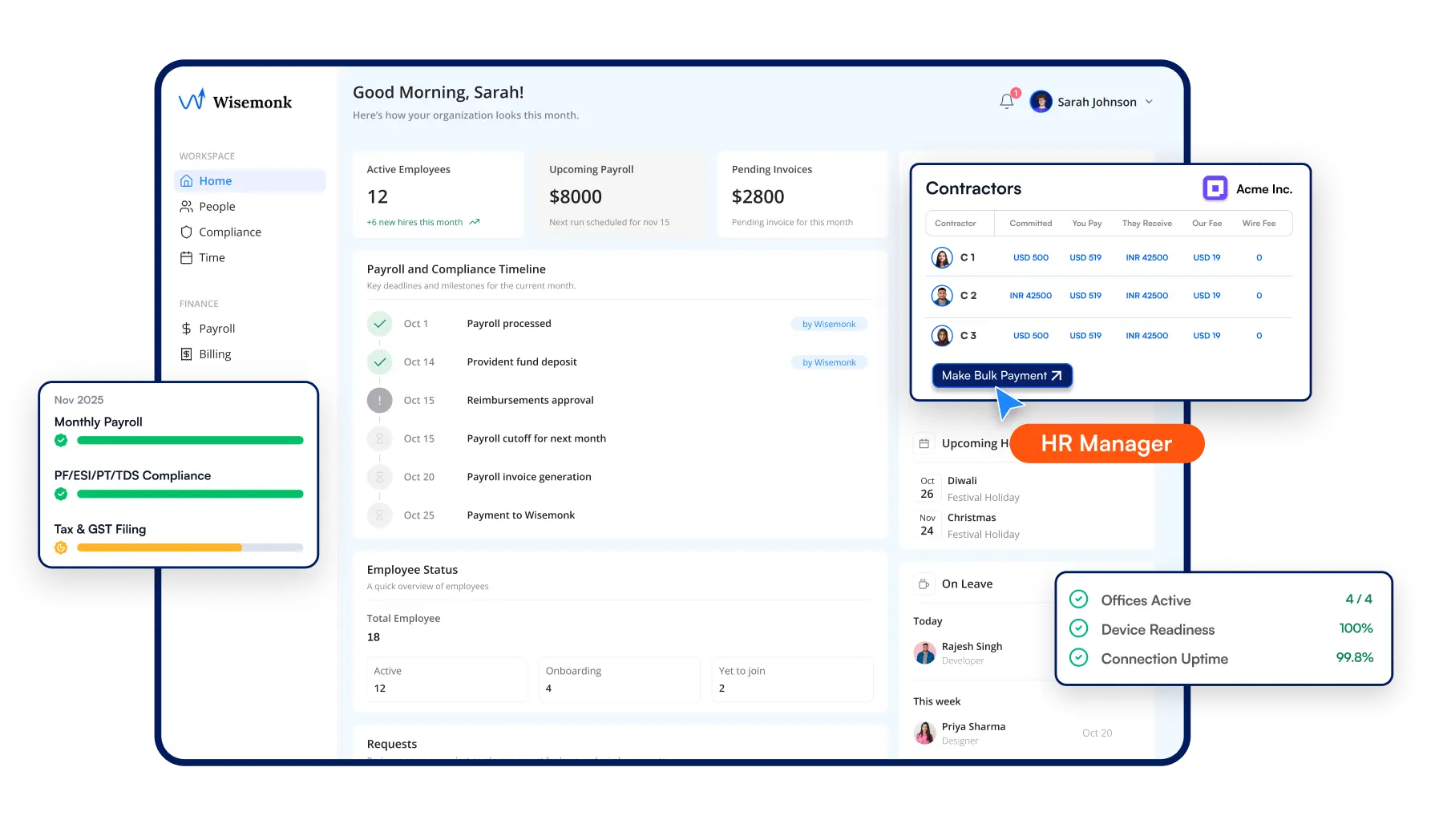
Why pick it over Rippling: Rippling's EOR for India requires a custom quote and runs through its global platform, which uses standardized templates that can miss India-specific nuances like state-level Professional Tax variations, PF edge cases, and gratuity calculations. Wisemonk has an in-house compliance team in India covering PF, ESI, gratuity, professional tax, and Shops and Establishments Act compliance across states, all backed by a 4.8/5 G2 rating and 24 to 48-hour onboarding.
When Wisemonk is the right fit: Your team is hiring in India (or India is a key part of your global workforce), you want local compliance depth over global breadth, and you want to save 70 to 80% compared to global EOR pricing for Indian hires.
When it's not the right fit: You need a single platform for HR, IT, and Finance across a primarily US-based workforce, or you need EOR coverage across many countries beyond India.
6. Deel
Best for global-first companies that need to onboard employees and contractors fast across a wide range of countries.
Deel's EOR starts at $599 per employee per month, with contractor management included free. It covers 160+ countries, including hard-to-reach markets in Sub-Saharan Africa, Central Asia, and the Caribbean that most competitors skip. Onboarding typically takes 2 to 5 days. The platform also includes a free HRIS, expense management, and integrations with 100+ tools like Greenhouse and QuickBooks.
Why pick it over Rippling: Broader country coverage, faster international onboarding, and a platform purpose-built for global hiring. Deel's free contractor management is a major cost advantage if you're managing a mixed workforce of employees and freelancers across multiple countries.
Limitations: Deel uses partner entities in roughly half its markets, meaning a third-party firm (not Deel) is the legal employer in those countries. US-focused HR features are secondary to its global capabilities. Support response times in APAC time zones have been flagged in reviews. At volume (20+ employees), you can negotiate down to $400 to $500 per month.
7. Remote
Best for companies that need 100% owned-entity EOR infrastructure with no third-party intermediaries.
Remote's EOR is priced at $599 per employee per month (annual) or $699 month-to-month. It covers 85+ countries for EOR and owns every single legal entity, with no partner intermediaries in any market. Remote also offers IP Guard, a proprietary feature that strengthens intellectual property protection in every employment contract. Contractor management starts at $29 per contractor per month.
Why pick it over Rippling: If your legal team or compliance requirements demand a direct employer chain with zero third-party entities, Remote is one of only two major providers (alongside G-P) that delivers this. The owned-entity model is especially valuable for companies in regulated industries like fintech, healthcare, and defense.
Limitations: Smaller country footprint than Deel or Multiplier. Less aggressive on volume discounts (floor is around $450 to $500 at scale vs. Deel's $350 to $400). Contractor management tools are more basic than Deel's. Not ideal for companies whose primary need is contractor payments.
8. Multiplier
Best for cost-conscious companies expanding into APAC and emerging markets who want solid EOR without paying premium prices.
Multiplier's EOR starts at $400 per employee per month, 33% lower than Deel and Remote's $599. Contractor management is $40 per contractor per month. It covers 150+ countries with particularly strong expertise in APAC markets. Onboarding takes 24 to 72 hours in most countries, and the platform offers ESOP management, a feature many competitors lack at this price point.
Why pick it over Rippling: Significantly lower EOR pricing with comparable country coverage. Multiplier's flat pricing model with no hidden setup fees makes budgeting predictable for finance teams. If your expansion is APAC-heavy, Multiplier's regional depth is a genuine advantage.
Limitations: Uses third-party entities in some markets rather than owned entities. Platform is less polished than Deel or Remote. Compliance depth in European and Latin American markets doesn't match its APAC strength. No free HRIS, equipment provisioning, or immigration support at the base tier. Volume discounts are limited compared to Deel's enterprise negotiations.
When should you actually stay with Rippling?[toc=Choose Rippling If]
This wouldn't be an honest guide if we only talked about why people leave. The truth is, Rippling is genuinely the best choice for a specific type of company.
If any of the following describe your situation, switching might create more problems than it solves:
- You need HR, IT, and Finance in one system: No alternative on this list replicates Rippling's unified data model. If you rely on device management, app provisioning, and spend tracking alongside payroll, one-click offboarding that revokes app access, wipes devices, and stops payroll simultaneously is hard to replace.
- You depend on cross-department automation: Rippling's no-code workflow builder triggers actions across HR, IT, and Finance from a single event. Moving to a payroll-only or EOR-only tool means rebuilding these workflows manually across disconnected platforms.
- You're a US company that also hires globally: Managing domestic and international employees from the same dashboard has real value. If you have 100+ US employees with a growing global team, that consolidation matters.
- You have 150+ employees: Rippling's support model improves at scale with phone support and dedicated account management. If you're at this level and satisfied with the service, that's worth factoring in.
- You're deeply integrated: Rippling connects with 500+ third-party tools. If your tech stack is wired into Rippling's ecosystem, migration means re-establishing all those connections elsewhere.
If you're actually using Rippling as a unified HR, IT, and Finance platform and leveraging its automation across all three, you're probably in the right place. The alternatives in this guide are for teams that only need part of what Rippling offers.
How do you switch from Rippling to an alternative?[toc=How to Switch]
Once you've decided to move, the actual migration doesn't have to be painful. Most modern HR platforms offer guided migration support and can get you up and running in 2 to 4 weeks.
Here's how to approach it:
- Audit what you're actually using: Before anything else, list every Rippling module your company actively uses: payroll, benefits, time tracking, device management, app provisioning, spend management. This tells you exactly what your replacement needs to cover and what you can drop.
- Export your employee data and payroll records: Download everything: employee profiles, payroll history, tax filings, PTO balances, benefits enrollment details, and contractor records. You'll need year-to-date payroll data for your new provider to file taxes accurately.
- Time the switch carefully: Don't migrate mid-pay-cycle. The cleanest transitions happen at the start of a new quarter or, ideally, January 1st. If payroll runs across two systems in the same tax year, W-2s and year-to-date records get fragmented, which creates compliance headaches.
- Handle the compliance handoff for international employees: If you have employees on Rippling's EOR, transitioning them to a new employer of record requires coordinating notice periods, employment contract transfers, and benefits continuity. Your new EOR provider should manage this process, but plan for 2 to 4 weeks of overlap.
- Plan for IT and device management transition: If you're using Rippling's IT Cloud for app provisioning and device management, map out how you'll handle SSO, software access, and hardware tracking after the switch. This is the piece most companies forget.
- Lean on your new provider's migration team: Most platforms (Gusto, Wisemonk, Deel, Remote) offer dedicated migration support. They'll tell you exactly what data they need, walk you through the timeline, and some will even run parallel payroll during your first cycle to catch any discrepancies before fully cutting over.
Frequently asked questions
Is Rippling worth it for small businesses?
Rippling can work for small businesses, but its modular pricing and platform complexity often make it more than what teams under 50 employees actually need. The real value of Rippling kicks in when you're using HR, IT, and Finance automation together. If you just need payroll and basic HR tools, platforms like Gusto (starting at $49/mo + $6/employee) or Justworks offer a simpler, more affordable experience without the learning curve.
What is the cheapest Rippling alternative?
For US payroll, Gusto's Simple plan at $49 per month plus $6 per employee per month is one of the most affordable options with transparent pricing. For global EOR, Multiplier starts at $400 per employee per month, significantly below Deel and Remote's $599. For India-specific hiring, Wisemonk starts at $99 per employee per month, making it the most cost-effective option for companies building teams in India.
Can I use Rippling just for payroll?
Technically yes, but you'll still pay the $35 per month base fee for the core Unity platform plus the per-employee charge for the payroll module. Since payroll is an add-on and not a standalone product, you're paying for platform access you may not fully use. For payroll-only needs, a dedicated payroll solution like Gusto or ADP is typically more cost-effective and easier to manage.
What is the best Rippling alternative for international hiring?
It depends on your scope. Deel ($599/employee/mo) and Remote ($599/employee/mo) offer the broadest global coverage for employer of record services across 160+ and 85+ countries respectively. Multiplier ($400/employee/mo) is a strong budget-friendly option, especially for APAC expansion. For companies hiring specifically in India, Wisemonk ($99/employee/mo) delivers deeper compliance expertise at a fraction of the cost of global platforms.
How long does it take to switch from Rippling?
Most modern HR and payroll platforms complete migration in 2 to 4 weeks. The cleanest transitions happen at the start of a pay period or quarter to avoid mid-cycle payroll disruptions. If you have international employees on Rippling's EOR, plan for additional overlap time to coordinate employment contract transfers and benefits continuity with your new provider.
Does Rippling offer EOR services?
Yes, Rippling offers employer of record services for international hiring, but it's an add-on to the broader platform, not a standalone product. Companies whose primary need is EOR often find better pricing, deeper local compliance support, and more focused service from dedicated EOR providers like Deel, Remote, or regional specialists like Wisemonk for India.
How does Rippling's pricing compare to its alternatives?
Rippling's core platform starts at $8 per employee per month plus a $35 base fee, but most companies pay $21 to $45 per employee per month once they add payroll, benefits, and IT modules. By comparison, Gusto starts at $49/mo + $6/employee for US payroll, Justworks PEO Basic is $59/employee, and global EOR providers range from $400 (Multiplier) to $599 (Deel, Remote) per employee per month. India-specialist EORs like Wisemonk start at $99 per employee per month, offering significant savings for companies focused on that market.
.webp)





.png)










.webp)
.webp)
.webp)
.webp)


.webp)
.webp)




.webp)
.webp)
.webp)




.webp)
.webp)

.webp)



.webp)
%20in%20India.webp)





.webp)